
378 km/h in a Williams: The Story Behind Bottas’ Baku Blast
Williams reported that Valtteri Bottas reached 378 km/h at Baku in 2016. The official finish-line reading was lower, and understanding the difference makes the story more interesting.
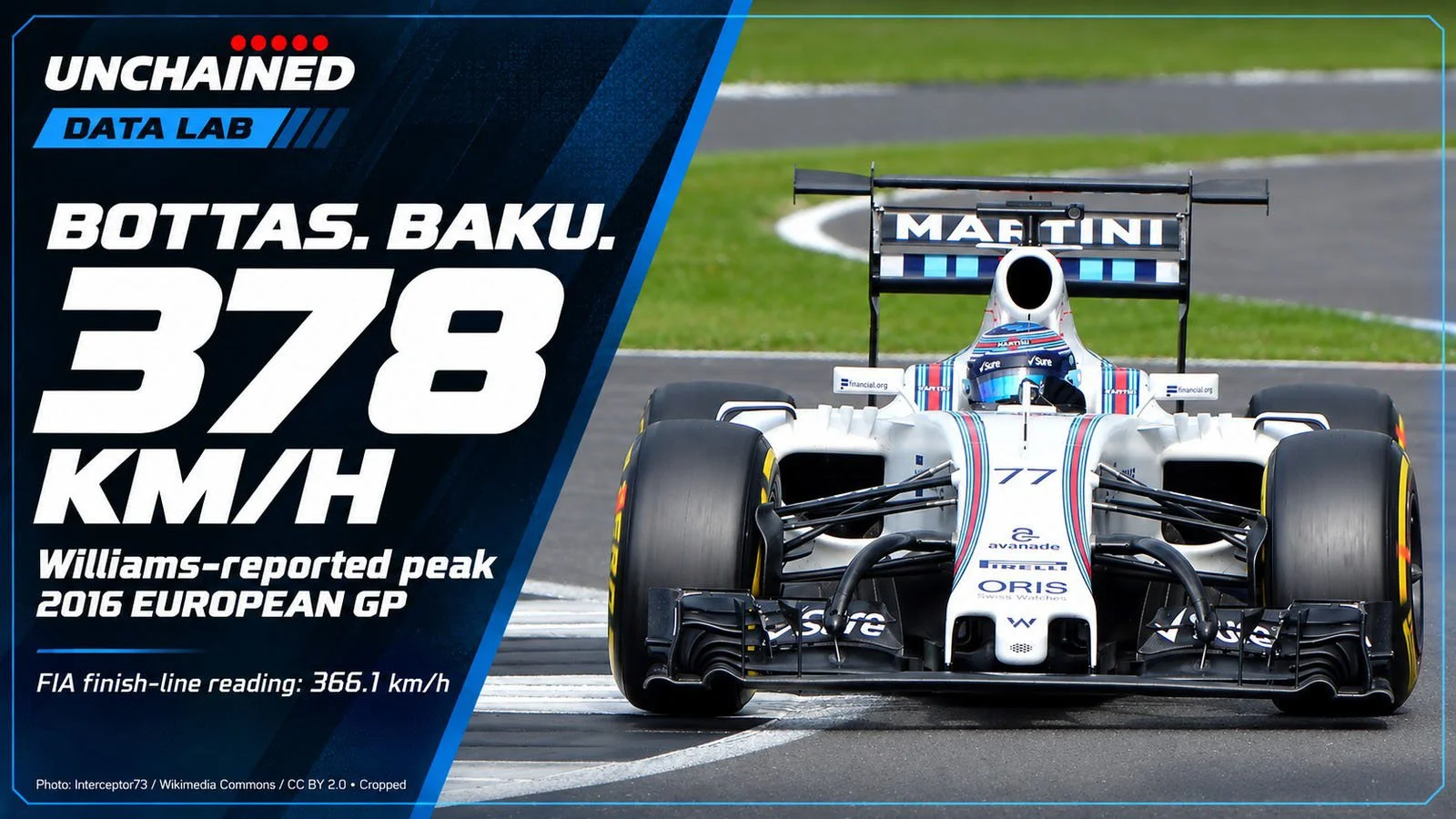
At 378 km/h, a car covers 105 meters every second. That’s the speed Williams says Valtteri Bottas reached on Baku’s first Formula 1 weekend in 2016.
The number is extraordinary. But before calling it an outright F1 record, there’s a distinction worth making: the official timing measurement and the peak reported by the team weren’t the same thing.
Two numbers, two measurements
The FIA’s qualifying maximum-speed sheet lists Bottas at 366.1 km/h at the finish line. That reading is directly documented in the event’s official results.
Williams reported a higher peak of 378 km/h from its car data. In the team’s account, Bottas continued accelerating before braking for Turn 1.
Those figures describe different measurements. One records his speed at a fixed point on the circuit. The other is the maximum the team says its data captured during the run.
The difference is 11.9 km/h. It doesn’t mean the FIA recorded 378 km/h, and the lower official reading doesn’t, by itself, disprove the team’s figure.
How the FW38 got there
Williams attributes the run to qualifying for the 2016 European Grand Prix, the name of Baku’s inaugural F1 event.
The team describes a low-drag FW38, an open DRS flap and a slipstream along the long run toward Turn 1. DRS reduces rear-wing drag, while following another car can reduce the aerodynamic resistance the trailing car encounters.
With less drag holding it back, the Williams could keep building speed.
It was a striking demonstration of what that car could do in those conditions. It wasn’t a measurement of its performance everywhere else around the lap.
Fastest down the straight doesn’t mean fastest around the lap
An F1 setup is a compromise. Reducing drag can improve straight-line speed, but teams also need downforce to carry speed through corners.
That trade-off was central to F1’s contemporary technical reporting on the run. Williams performance engineering chief Rob Smedley discussed the 378 km/h figure while explaining that a race setup with more wing would sacrifice some top speed.
A car can therefore lead a speed chart without being the quickest over a complete lap. Braking, cornering and acceleration all count toward the stopwatch.
The big number captures one part of the performance. It doesn’t settle the rest.
Where the record claim needs care
Bottas also recorded 372.5 km/h through the official speed trap during the 2016 Mexican Grand Prix. That was a race measurement at a different circuit, separate from the team-reported Baku peak.
Dedicated land-speed runs are another category again. Honda’s modified F1 machinery exceeded 397 km/h at Bonneville in 2006, away from the demands of a Grand Prix circuit.
For this story, the precise description is the strongest: Williams reported a 378 km/h peak for Bottas at Baku in 2016.
Ahead of another Azerbaijan Grand Prix, that remains a remarkable piece of the circuit’s history. It also shows why a speed statistic becomes more useful when you know where it was measured, how it was recorded and what it actually represents.
