
The Five F1 Drivers Who Have Won at the Most Different Circuits
Hamilton leads on 31, with Verstappen reaching 27 in Singapore, but the stories behind the top five show how teams, timing and changing calendars shaped their records.
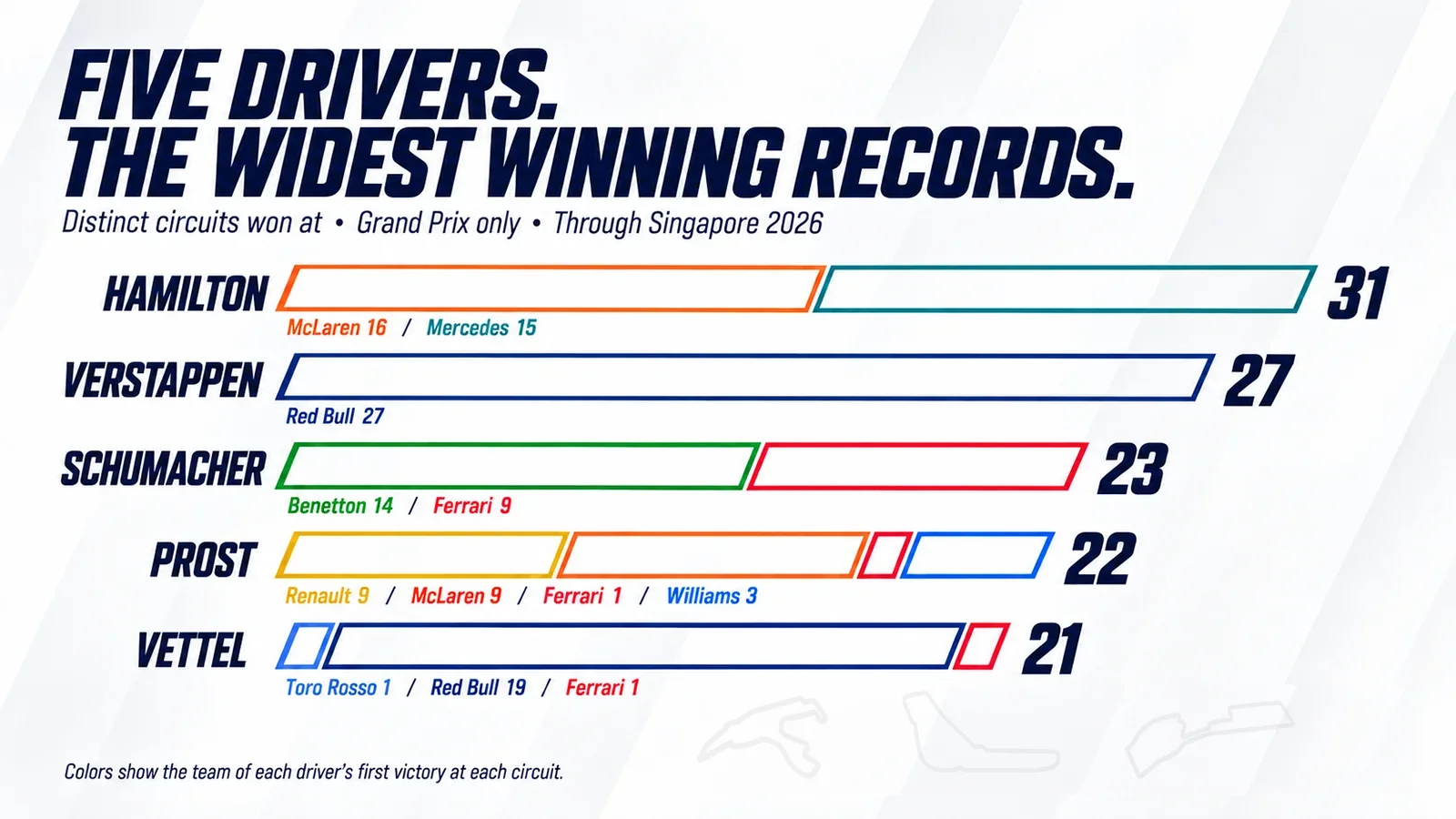
Winning again at a favorite circuit adds another trophy. Winning somewhere new adds something different: another venue to a driver’s career record.
Through the 2026 Singapore Grand Prix, five drivers have won at more than 20 different circuits. Their totals cover very different careers, from Alain Prost’s French Grand Prix victories at three separate venues to Lewis Hamilton’s run of five additions across two seasons.
World Championship Grand Prix victories through October 11, 2026. Sprints and non-championship races excluded.
The top five
1. Lewis Hamilton — 31 circuits
2. Max Verstappen — 27 circuits
3. Michael Schumacher — 23 circuits
4. Alain Prost — 22 circuits
5. Sebastian Vettel — 21 circuits
Hamilton: five additions in two seasons
Hamilton had already won at 16 different circuits when he left McLaren. Mercedes supplied his first victories at another 15.
Five of those additions arrived across 2020 and 2021. Mugello, Portimão and Imola expanded his record in 2020; Lusail and Jeddah followed the next year.
That stretch shows how a changing calendar can create fresh opportunities even for an established winner. Hamilton still had to convert them, and he did so at all five venues.
Verstappen: Singapore makes 27
Verstappen’s Singapore victory added a 27th circuit to a record built entirely with Red Bull.
His list began at Barcelona in 2016. It now includes traditional venues such as Silverstone and Suzuka alongside newer additions to F1’s calendar, including Miami and Las Vegas.
Singapore expanded that range again in 2026, leaving him four circuits behind Hamilton at this cutoff.
Schumacher: the final win added the final venue
Schumacher had won at 14 different circuits with Benetton before moving to Ferrari. His Ferrari years added nine more.
The last addition was Shanghai in 2006. That victory became both his 91st and final Grand Prix win and his first at the Chinese circuit.
It’s a useful distinction: a driver can spend years adding victories at familiar venues, then expand this particular record with a single result.
Prost: three French venues, three entries
Prost’s 22 places him just one circuit behind Schumacher.
His French Grand Prix wins illustrate why the venue matters more than the event’s title. Dijon-Prenois, Paul Ricard and Magny-Cours were three different winning circuits.
His first victories at new venues came with four constructors: nine with Renault, nine with McLaren, one with Ferrari and three with Williams.
Vettel: more victories, no new circuits
Vettel reached 21 with his Hungarian Grand Prix victory for Ferrari in 2015. His later wins increased his career total without adding another venue.
Monza had opened his account with Toro Rosso in 2008. Red Bull supplied 19 additions before Ferrari added the Hungaroring.
That Ferrari segment of one doesn’t mean Vettel won at only one circuit for the team. It means Ferrari added one venue where he hadn’t already won.
What the numbers measure
Each venue counts once, regardless of repeat victories, different Grand Prix titles or layout revisions. The graphic’s colors identify the team with which each driver first won at that venue.
The ranking measures the geographical spread of their winning records. It doesn’t settle who was the better driver.
Longer calendars create opportunities, but venue turnover matters too. A shorter annual schedule can still take a driver to many different circuits over a career. Career length, repeated attempts, competitive machinery and reliability all influence which opportunities become victories.
