
Which F1 Teams Have the Biggest Points Gap Between Their Current Drivers?
Bearman holds 76.7% of the points scored by Haas’s current pair, compared with Verstappen’s 69.5% at Red Bull, while Hamilton and Leclerc are almost evenly matched.
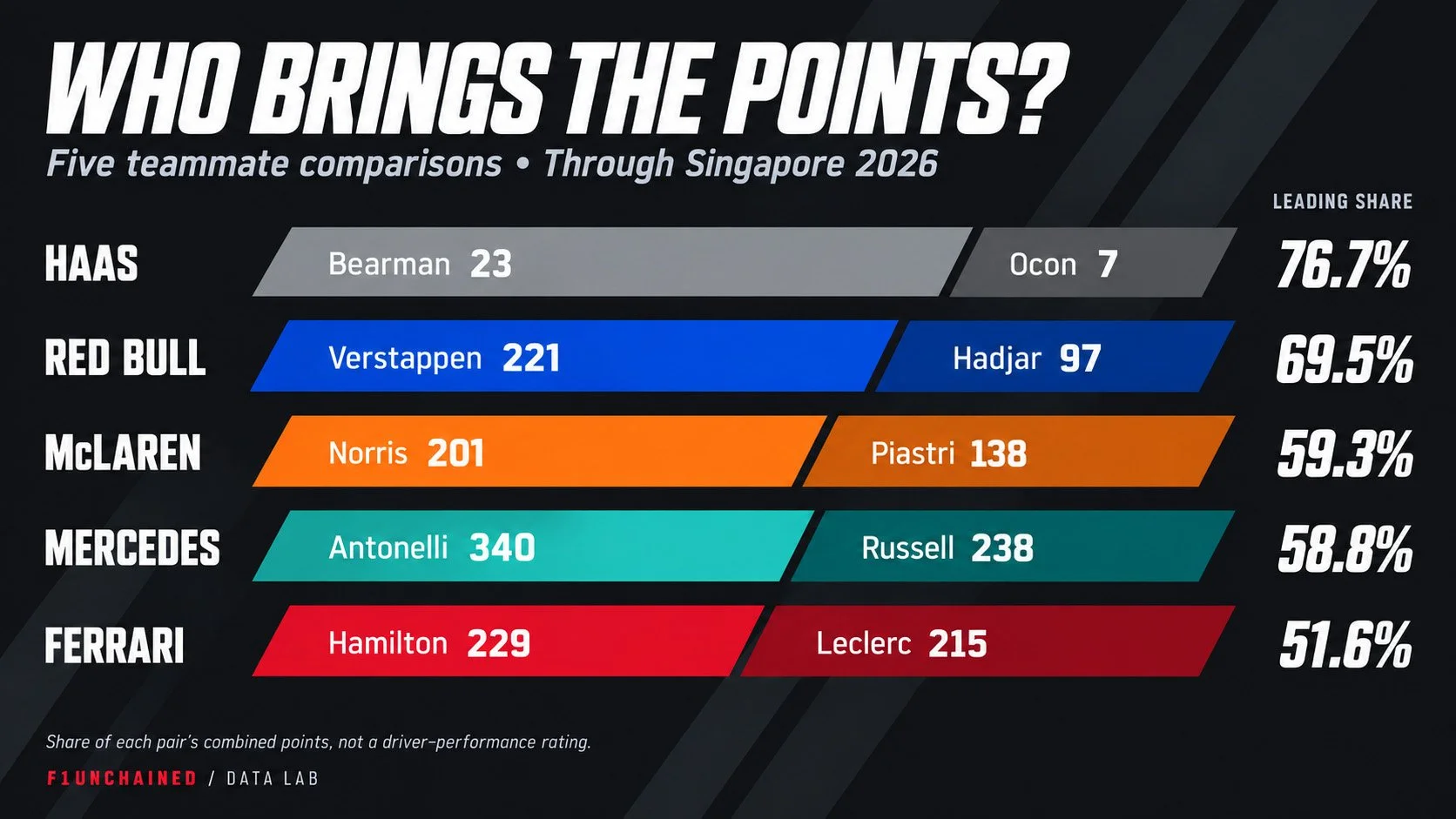
Oliver Bearman has 23 points to Esteban Ocon’s seven. Max Verstappen leads Isack Hadjar by 221 to 97. Lewis Hamilton and Charles Leclerc are separated by just 14.
Those gaps tell different stories. Verstappen has the largest points advantage of those three comparisons, but Bearman holds the larger percentage of his pair’s combined score. Ferrari’s division is much closer to equal.
Comparing both points and percentages shows how the current teammates stack up without treating every gap as equivalent.
Individual championship points through the Singapore Grand Prix, October 11, 2026. Sprint points included. Each comparison uses the current teammates’ full-season driver totals, including points earned with another team.
The complete grid comparison
The percentage shown is the leading driver’s share of the current pair’s combined points.
Aston Martin — Alonso: 100%
Alonso 7; Stroll 0. Combined: 7.
Haas — Bearman: 76.7%
Bearman 23; Ocon 7. Combined: 30.
Red Bull — Verstappen: 69.5%
Verstappen 221; Hadjar 97. Combined: 318.
Racing Bulls — Lawson: 66.4%
Lawson 75; Lindblad 38. Combined: 113.
Alpine — Gasly: 60.3%
Gasly 41; Colapinto 27. Combined: 68.
McLaren — Norris: 59.3%
Norris 201; Piastri 138. Combined: 339.
Mercedes — Antonelli: 58.8%
Antonelli 340; Russell 238. Combined: 578.
Williams — Sainz: 58.3%
Sainz 7; Albon 5. Combined: 12.
Audi — Hülkenberg: 56.5%
Hülkenberg 13; Bortoleto 10. Combined: 23.
Ferrari — Hamilton: 51.6%
Hamilton 229; Leclerc 215. Combined: 444.
Cadillac — no percentage split yet
Bottas 0; Pérez 0. With neither driver having scored, their shares are undefined.
Bearman’s larger share, Verstappen’s larger gap
Bearman holds more than three-quarters of the points scored by Haas’s current drivers. Among pairs where both drivers have scored, that is the most uneven split.
His advantage over Ocon is 16 points. Verstappen’s lead over Hadjar is 124, yet his percentage is smaller because their combined total is much higher.
That distinction matters. Percentage measures the balance within a pair; the points gap shows the size of the difference.
Ferrari’s two substantial contributions
Hamilton accounts for 51.6% of Ferrari’s pair total, with Leclerc supplying 48.4%. Both have passed 200 points.
It is the closest percentage split among the current pairs that have scored. Ferrari’s balance comes from two substantial totals, rather than two drivers separated by a handful of points near the bottom of the standings.
McLaren and Mercedes have similar divisions. Norris holds 59.3% against Piastri, while Antonelli holds 58.8% against Russell. Their percentages are close, although Antonelli’s 340 points considerably exceed Norris’s 201.
Why these aren’t constructor totals
Lawson’s full 75 points count in his comparison with Lindblad, including the 14 he earned during his Red Bull stint.
That makes their combined driver total 113. Racing Bulls’ constructor total is 100: Lawson’s 61 scored for the team, Lindblad’s 38 and substitute Yuki Tsunoda’s one.
Likewise, Verstappen and Hadjar combine for 318, while Red Bull has 332 because Lawson’s 14 remain part of its constructor score.
These comparisons describe the drivers currently paired together. They do not isolate points earned as teammates or measure equal numbers of appearances in the same car.
What the percentages can tell us
Alonso holds 100% of his pair’s points, but that represents seven points. Antonelli’s smaller percentage represents 340.
Reliability, incidents, missed races and competitive machinery can all influence the totals. The split identifies how unevenly the current drivers have scored; it doesn’t establish why, or rank their ability.
Bearman’s large share and Ferrari’s near-even division are both meaningful. Reading the points beside the percentages keeps those differences in perspective.
