
F1 Returns to Sepang. Five Stats That Make This Comeback Worth the Wait.
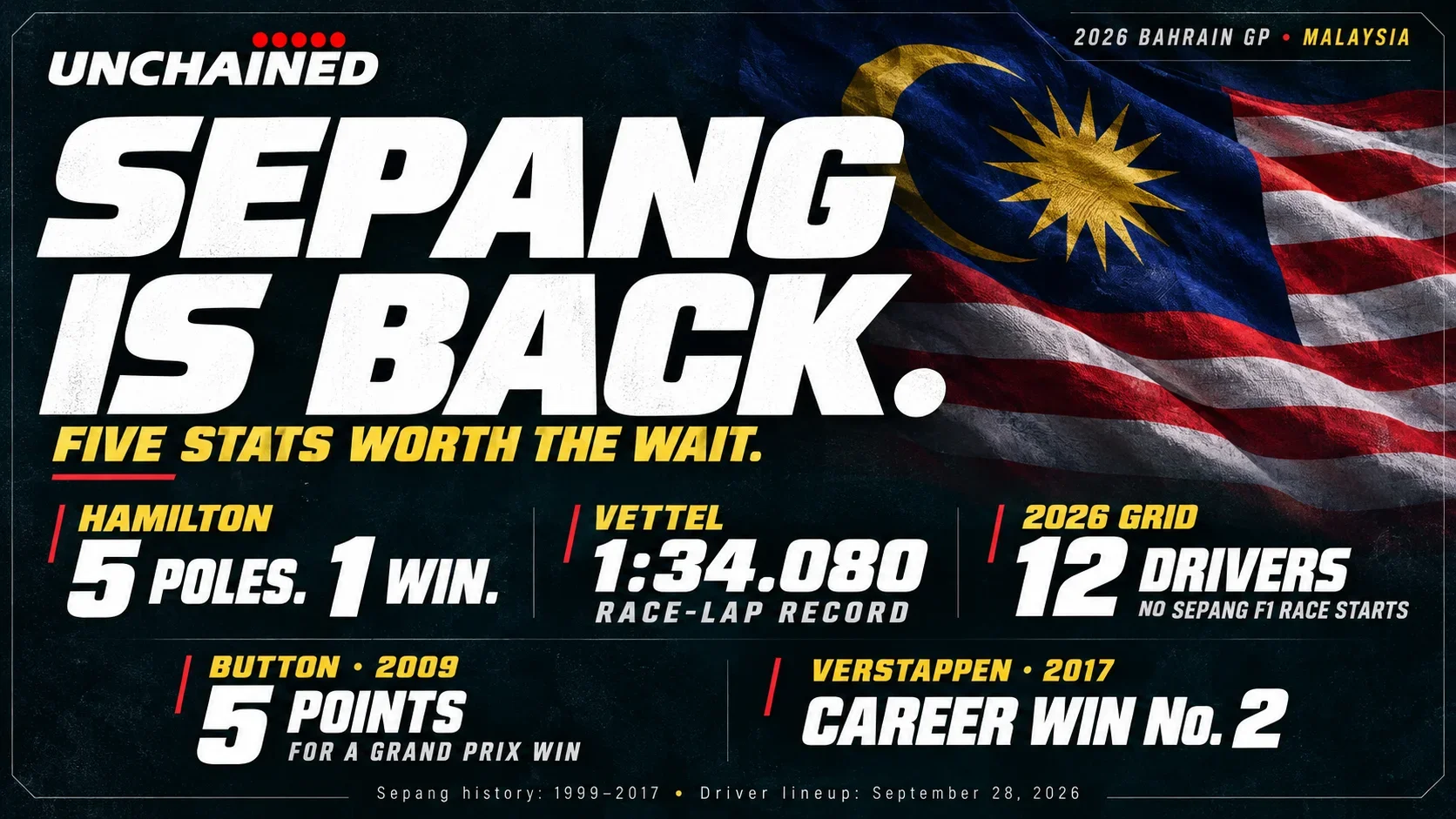
Hamilton’s five poles produced one victory, Button won a race worth just five points, and more than half the current grid has never started an F1 Grand Prix at Sepang.
The Bahrain GP brings Formula 1 to Malaysia this weekend, reopening a circuit’s history that stopped in 2017.
Sepang hosted 19 World Championship races between 1999 and 2017. These five numbers explain why its return offers more than nostalgia.
Hamilton: five poles, one win
Lewis Hamilton shares Sepang’s pole record with Michael Schumacher, with five apiece. Turning those starts into victories proved much harder.
Hamilton took pole in 2012, then every year from 2014 through 2017. His results were third, first, second, retirement and second. One win from five poles means a 20% conversion rate.
Those outcomes had different explanations. The clearest warning against blaming the driver came in 2016, when his engine failed while he was comfortably leading. The qualifying record shows his speed here. The win total doesn’t tell the whole story.
Vettel: four wins and one unfinished benchmark
Sebastian Vettel remains Sepang’s most successful F1 driver, winning in 2010, 2011, 2013 and 2015. His first three victories came with Red Bull; the fourth came with Ferrari.
He also left with the race-lap record: 1:34.080, set on lap 41 in 2017 while recovering from the back of the grid to fourth.
That time came during a chase, not a winning cruise. It remains the benchmark because F1 hasn’t raced here since. This weekend finally gives a new generation of cars its first race opportunity to replace it.
Twelve drivers, no Sepang F1 race starts
Twelve of the current 22 drivers have never started an F1 race at Sepang. That includes both Mercedes drivers, both McLaren drivers and Charles Leclerc.
George Russell, Lando Norris and Oscar Piastri have built their entire Grand Prix careers since F1’s last visit. For them, this return adds a new race venue to familiar championship demands.
But “no race starts” doesn’t mean no experience. Leclerc drove a Sauber in first practice here in 2017, completing ten laps in wet conditions. Practice appearances and Grand Prix starts belong in different columns.
Button: a victory worth five points
Jenson Button’s 2009 win earned him five points, half the usual ten awarded for victory that season.
The race was scheduled for 56 laps, but torrential rain brought out the red flag on lap 33. It never restarted, and the official classification was counted back to lap 31.
Button kept the victory for Brawn, while the shortened distance meant half points. It’s a reminder of how dramatically conditions have changed a Sepang race, rather than a forecast for this weekend.
Verstappen: only career win number two
The last F1 race at Sepang took place on October 1, 2017, one day after Max Verstappen turned 20.
He passed polesitter Hamilton early in the race and went on to win for Red Bull. It was only his second Grand Prix victory.
That puts the gap between visits into perspective. Verstappen returns as the circuit’s most recent F1 winner, while many of the drivers now racing against him are preparing for their first Sepang Grand Prix start.
