
Pérez’s career looks different when you break it down by team. The wins tell one story. The years spent turning smaller opportunities into points tell another.

Sergio Pérez reached the podium three times with Sauber. His move to McLaren produced none.
That contrast is a useful place to start as he approaches his 300th Grand Prix start. In Formula 1, moving to a bigger name doesn’t always bring better opportunities. And the same finishing position can mean very different things depending on the car beneath you.
If Pérez starts Sunday’s Mexico City Grand Prix, he’ll reach that milestone at home. But the more revealing story is how his results changed across the teams that brought him there.
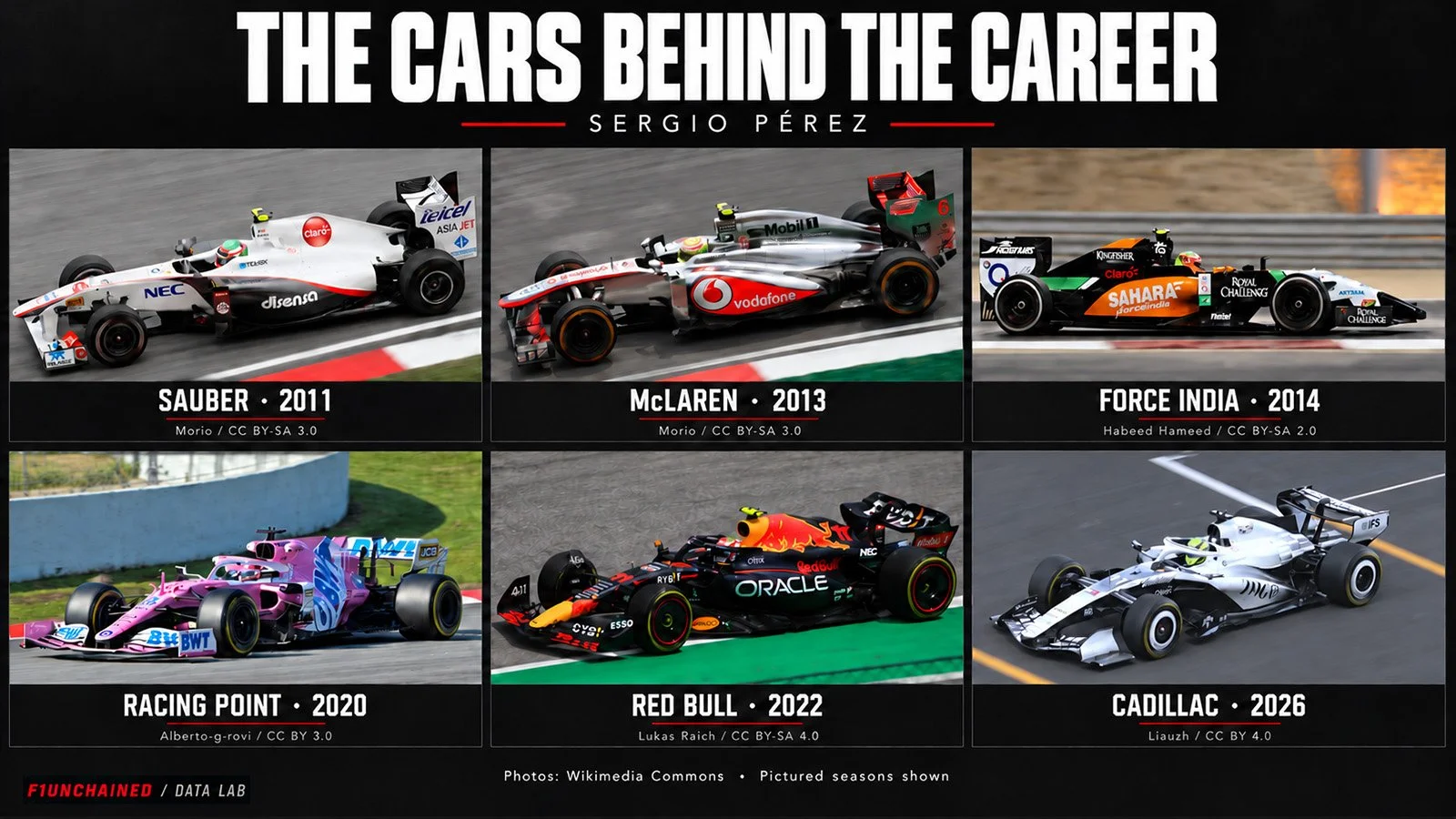
What the numbers show
Counting Grand Prix starts through the 2026 United States GP, here’s how his career breaks down. Percentages show how often each result occurred per start.
Sauber | 2011–12
37 starts
Points finishes: 12 (32.4%)
Podiums: 3 (8.1%)
Wins: 0
McLaren | 2013
19 starts
Points finishes: 11 (57.9%)
Podiums: 0
Wins: 0
Force India | 2014–18*
99 starts
Points finishes: 69 (69.7%)
Podiums: 5 (5.1%)
Wins: 0
Racing Point | 2019–20
36 starts
Points finishes: 24 (66.7%)
Podiums: 2 (5.6%)
Wins: 1 (2.8%)
Red Bull | 2021–24
90 starts
Points finishes: 70 (77.8%)
Podiums: 29 (32.2%)
Wins: 5 (5.6%)
Cadillac | 2026 through Austin
18 starts
Points finishes: 0
Podiums: 0
Wins: 0
Grand Prix results only; Sprints excluded. Wins are included in podium totals.
The Force India chapter includes the Racing Point Force India entry introduced during 2018. The Racing Point chapter covers 2019–20.
The career before the winning car
Pérez’s three Sauber podiums all came in 2012: second in Malaysia and Italy, third in Canada. Those performances helped earn him the McLaren seat for the following season.
Yet McLaren finished fifth in the 2013 constructors’ championship. Pérez scored more regularly than he had across his Sauber spell, but the podiums disappeared. The move brought a famous badge without the breakthrough it had promised.
Force India became the longer, steadier chapter. Across five seasons, Pérez scored in almost seven out of every ten starts.
That record deserves attention because midfield consistency is easy to overlook. A podium becomes a career highlight. A succession of points finishes rarely gets the same treatment, even when those results sustain a team’s championship campaign.
Red Bull changed the scale
The clearest change at Red Bull was podium frequency.
Pérez’s points-finishing rate rose from 69.7% at Force India to 77.8% at Red Bull. His podium rate increased much more sharply, from 5.1% to 32.2%.
Those figures describe different competitive opportunities. They don’t tell us exactly how much came from the driver, the car, reliability or the opposition. They also don’t excuse missed opportunities in a stronger machine.
But they explain why judging an entire career by its most visible years leaves so much out.
And his first victory came before Red Bull. At Sakhir in 2020, Pérez recovered from an opening-lap collision to win for Racing Point, on a night when Mercedes’ race unraveled. He still had to put himself in position to take that opportunity.
Cadillac brings a different test
Through Austin, Pérez has yet to score for Cadillac. His best Grand Prix finish this season is 14th.
That is a stark change from his Red Bull years. It also makes this latest chapter difficult to measure through trophies alone. Cadillac is in its first season, and the team has now committed to Pérez until at least 2029.
The results still matter. Experience has to contribute to progress, and eventually that progress needs to appear on the timing screens.
For now, his career offers a reminder worth carrying into Mexico: success in Formula 1 has a changing threshold. Sometimes it means winning. Sometimes it means making the points a habit. For a new team, the first points can become a milestone of their own.
