
Singapore’s Safety Car Streak Ended. Then It Stayed Away.
Singapore’s first 14 Grands Prix all featured a Safety Car, but two uninterrupted editions have challenged one of Marina Bay’s familiar strategic assumptions.
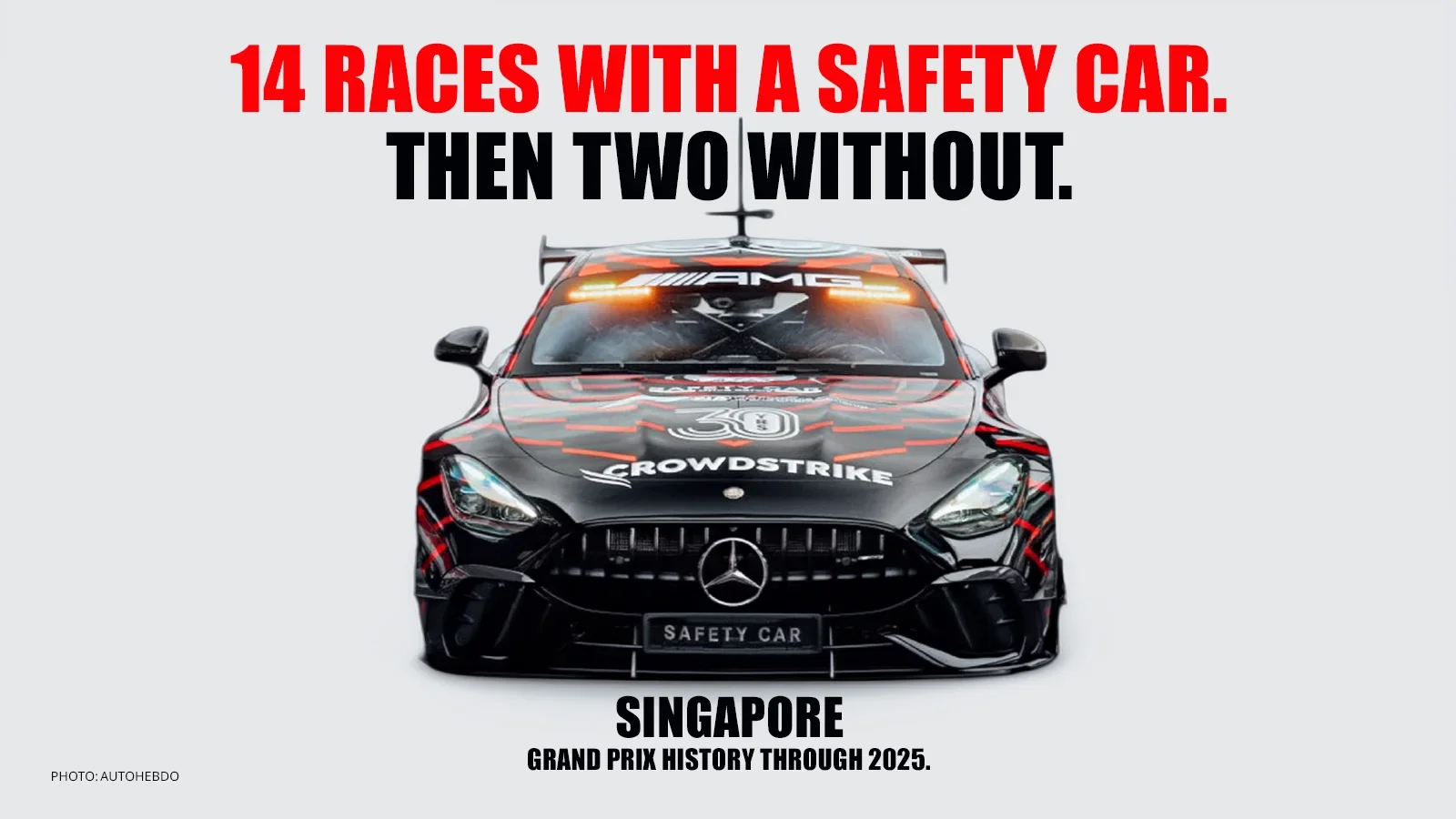
For years, Singapore gave teams a reliable piece of history to work with: every Grand Prix here had required the Safety Car.
Then came 2024. No Safety Car. In 2025, it stayed parked again, and all 20 drivers finished.
That doesn’t make the next race predictable. It makes relying on the old pattern harder.
Historical figures cover Singapore’s 16 Formula 1 Grands Prix through 2025. The upcoming 2026 Sprint and Grand Prix are excluded. Safety Car figures refer to physical deployments, not Virtual Safety Car periods.
Fourteen races built the expectation
Every Singapore Grand Prix from its 2008 debut through 2023 featured at least one Safety Car intervention. That’s 14 races, with no editions held in 2020 or 2021.
Including the two races since, the historical count stands at 14 of 16, or 87.5%.
That percentage describes what happened. It isn’t an 87.5% forecast for 2026. It also counts races with an intervention, not the total number of times the Safety Car appeared.
The distinction matters when turning a historical statistic into a strategy discussion.
Waiting can carry a cost
A Safety Car slows the field, potentially reducing the time a driver loses relative to rivals by making a pit stop. That can reward a team that keeps its options open.
But extending a stint has a cost if worn tires are losing time and the expected interruption never comes.
Mercedes encountered that uncertainty with Lewis Hamilton in 2024. His soft-tire start led to an early stop and a long stint on hard tires. The team had fresh mediums available, which could have become useful under a well-timed Safety Car.
Without one, Mercedes calculated that the extra pace wouldn’t recover the time lost making another stop. Hamilton finished sixth. The team acknowledged that starting on softs had been a mistake; the absent Safety Car offered no way out.
Two races changed the picture
The 2024 race broke the streak. The 2025 edition repeated the absence and became Singapore’s first Grand Prix without a retirement.
Two races don’t establish a permanent change. They do provide a useful counterweight to the previous 14.
For 2026, the challenge is to keep a strategy flexible enough to benefit from an interruption without needing one to make it work.
