
A rear wing that stays closed, an overtaking aid switched off and tires prepared at different temperatures. Brazil’s rain reveals how much changes beyond the tread.
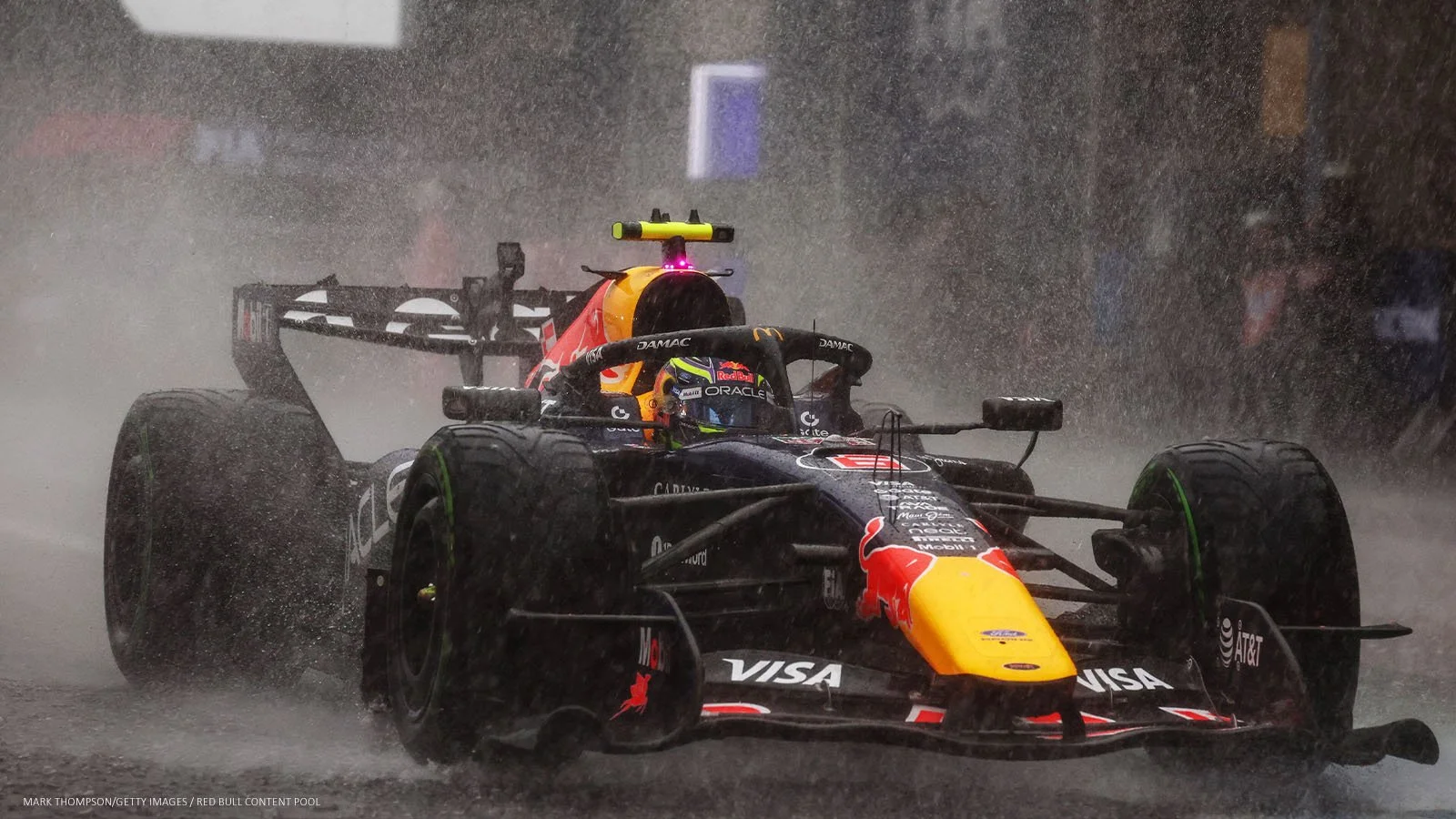
The tire change takes seconds. The changes to what a driver can do with a 2026 F1 car go much further.
Brazil’s rain-hit qualifying brought that into focus. Under the FIA’s rules, the race director can declare “Low Grip Conditions,” triggering restrictions on aerodynamics and power delivery. It’s a formal change in how the cars operate, rather than every driver simply selecting a preferred rain setting.
The front wing can move. The rear stays closed.
In normal conditions, the movable sections of both wings can adopt Straight Mode in designated zones, reducing aerodynamic drag.
Under low-grip rules, only partial activation is permitted: the front wing can move into Straight Mode while the rear remains in its higher-downforce Corner Mode position.
That keeps the rear wing from shedding downforce as it would during normal straight-line running. So if you see the front wing move while the rear stays closed, it can be the wet-weather configuration doing exactly what it should.
Overtake disappears, but Boost has a different job
The FIA’s current sporting rules disable Overtake in low-grip conditions. Drivers lose that particular electrical assistance for attacking another car.
Boost is treated differently. It can prevent a reduction in the driver’s maximum power demand, but it cannot increase that demand. In plain English, it can help hold the requested power rather than ask for more.
Electrical delivery also follows specific low-grip power limits. The technical regulations set an absolute electrical ceiling of 350 kW, but that isn’t a promise of 350 kW whenever the accelerator goes down. Wet-weather delivery follows separate FIA-prescribed curves.
Intermediates leave the blankets hotter than full wets
Here’s a detail the television pictures won’t tell you.
Pirelli’s published Brazil instructions allow intermediate tires to be heated to 70°C, while full wets are limited to 40°C, with a maximum heating time of two hours.
Those figures refer to the tire’s tread and sidewall temperatures, not simply the number selected on the blanket controller. They’re preparation limits, not target temperatures for every lap.
The FIA increased intermediate heating temperatures earlier this season to improve initial grip. That helps explain why preparing for rain involves more than choosing how much water a tire can clear.
A wet-weather lap therefore asks the driver to work with a different aerodynamic balance, restricted electrical tools and a different tire preparation process. The challenge begins well before the first puddle.
