
The prize awaiting Sunday’s winner carries more than a finishing position. Its titanium curves hide references to F1’s sound, the Senna S and Brazil itself.
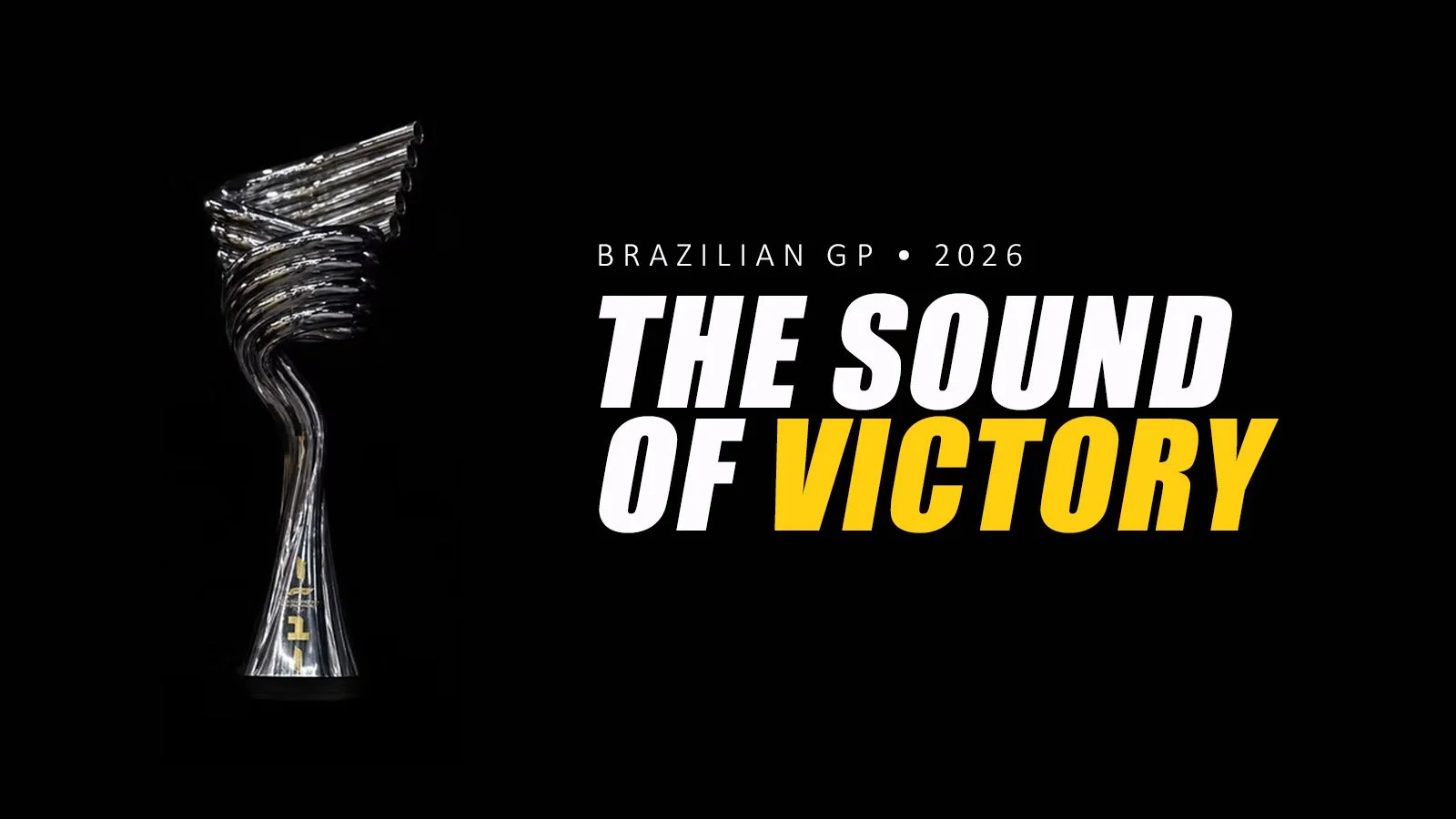
The inspiration for this year’s São Paulo Grand Prix trophy starts with something fans once heard long before they saw the car: a Formula 1 V10.
Designed by Brazilian studio Secret Weapon and manufactured by BTOMEC in Joinville, the trophy takes its shape from an exhaust manifold. Its five flowing tubes reference the exhaust pipes from one bank of a V10 engine.
But look at it from another angle, and the engine reference becomes something else.
Viewed from above, the upper section evokes the Senna S, including the descent through Interlagos’ opening corners. From other perspectives, the curves suggest a waving checkered flag and the outline of Brazil. Details around the base recall the circuit’s curbs.
There is music in the design, too. According to Secret Weapon, the five tubes also represent the five lines of a musical staff, while another view suggests an eighth note. Those references connect the engine’s distinctive sound with Brazil’s musical identity.
Making those shapes required more than conventional metalwork.
The trophy was built from titanium powder using selective laser melting, a form of metal 3D printing. A laser fuses the material layer by layer, allowing the complex curves to take shape.
According to the race organizer, each piece required around 190 hours of laser manufacturing, followed by approximately 500 hours of finishing. The full development and production process took ten months.
Even the Brazilian colors have an engineering explanation. Secret Weapon says the green, yellow and blue shades come from controlled oxidation of the titanium. Microscopic surface layers change how light reflects, producing color without paint or pigment.
The winner’s trophy stands 55 centimeters tall and weighs 5.7 kilograms. When it is raised on Sunday, watch how its shape changes as it turns. The exhaust pipes, circuit and flag are all part of the same piece.
