
Mercedes Added Downforce. So Why Did Its Car Become Harder to Drive?
Mercedes’ upgrade strengthened the front of the car more than expected. Singapore offered a clearer direction for making that extra performance usable.
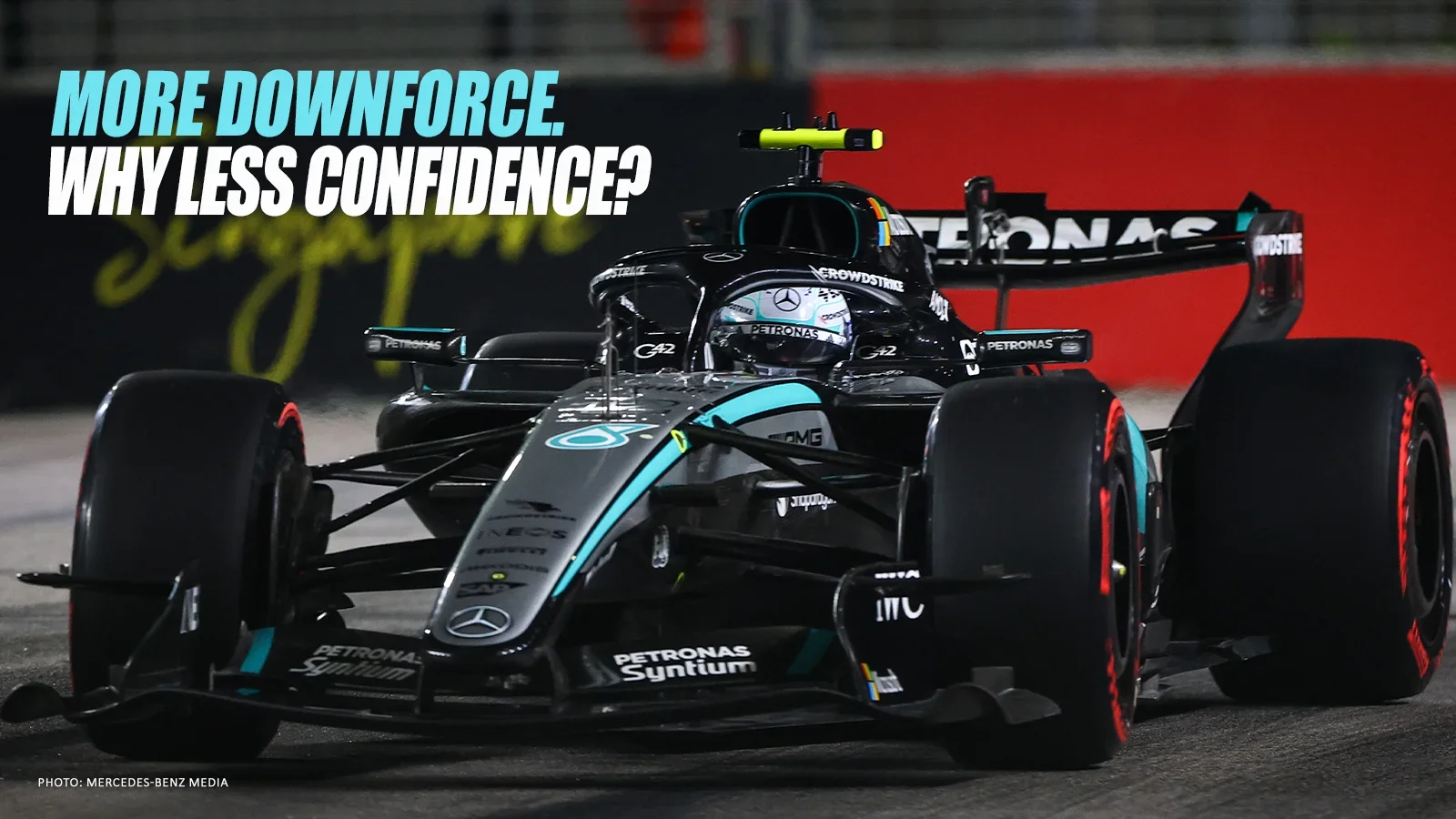
Mercedes found the extra downforce it wanted. The difficulty was keeping the car balanced as conditions changed around a lap.
Deputy technical director Simone Resta explained that the gains were uneven across the car’s operating conditions, shifting its aerodynamic balance farther forward than anticipated. That left the drivers with a more demanding car to manage.
The floor and sidepod changes introduced at Sepang therefore brought Mercedes a second engineering task: adapting the setup to make the new package work consistently.
Why the balance matters
Downforce presses a car toward the track, helping its tires generate grip. But the total amount tells only part of the story. Its distribution between the front and rear also affects how the car responds when a driver turns into a corner.
A strong front end helps the car change direction. If the rear cannot support that response, the driver has to manage a tendency for the back of the car to slide outward, known as oversteer.
That relationship changes as the car moves through a corner. Speed, ride height and wind can all affect aerodynamic behavior. Tire condition adds another variable.
The “operating window” is the range of conditions and settings in which those elements work well together. A narrow window makes finding a dependable setup more difficult.
Mercedes’ own setup guidance explains why this involves several adjustments. Wing settings and ride heights influence aerodynamic behavior, while suspension settings affect how the car uses its tires. Engineers must find a combination that also suits the driver.
Singapore showed there was performance to find
Mercedes compared specifications in Singapore, with George Russell using the older package and Kimi Antonelli continuing with the upgrade.
The team’s Sunday assessment was encouraging. Trackside engineering director Andrew Shovlin said Antonelli’s package was clearly faster by the end of the weekend, after Mercedes moved closer to the settings it needed.
Antonelli finished third, but his assessment was more useful than treating the podium as proof that everything was solved. He said the Sprint format had limited how much Mercedes could change after a difficult Friday.
“It wasn’t like we had the car in the perfect window today,” he said in the team’s race report.
Toto Wolff also acknowledged that the upgrade was harder to set up, while pointing to improved performance in qualifying and the race. Together, those assessments describe a package with potential that Mercedes was still learning to use.
Austin is the next test
Autosport reports that Mercedes plans further mechanical adjustments and another run with the front wing tested during Singapore practice.
Those are intended next steps. Their effectiveness still has to be established on track.
For Mercedes, the useful test in Austin will be whether its drivers can access the car’s performance more consistently as conditions change. Singapore gave the team evidence of progress and a clearer setup direction. The remaining work is turning that understanding into a car they can trust throughout a lap.
