
NO TYRES. JUST RAILS: RED BULL’S TITLE-WINNING RB8 GOES UNDER MADRID
Sebastian Vettel’s 2012 title-winning RB8 swapped racing tyres for precision-machined metal wheels beneath Madrid—an extraordinary engineering stunt tied directly to a Spanish GP plan that estimated 90% of fans could reach the paddock by public transport.
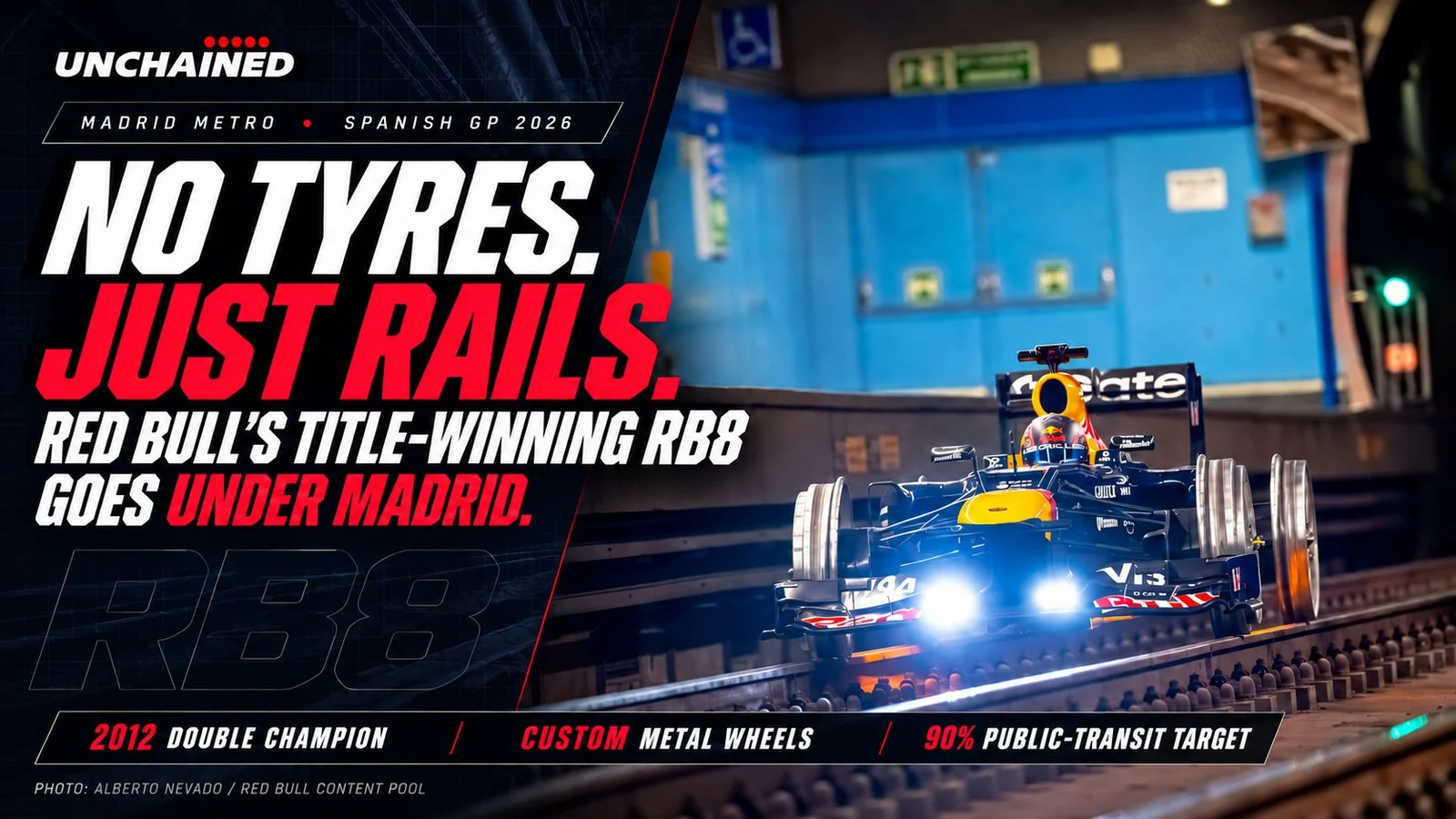
A Formula 1 car should have no business inside a Metro tunnel. Red Bull put one there anyway—and not simply for the spectacle. Ahead of the Spanish GP, the team sent its 2012 RB8 beneath Madrid with headlights blazing, custom metal wheels and former F1 driver Patrick Friesacher at the controls. The result was part engineering experiment and part preview of the transport network expected to move race-weekend crowds to Madring.
The RB8 carried Sebastian Vettel to the 2012 Drivers’ Championship and helped Red Bull secure the Constructors’ Championship that same season. Putting it on railway tracks required the Red Bull Racing Heritage Team and Spanish engineering and creative group Andtonic to solve a problem the car was never designed to face: keeping a Formula 1 machine aligned with two fixed metal rails without substantially modifying either the RB8 or the railway.
The Metro’s track width proved compatible with the car, but early wheel prototypes were too heavy and risked damaging its suspension, gearbox and driveshafts. Engineers developed purpose-built metal wheels with a central hub and precision-machined spokes, removing unnecessary mass while retaining the strength required to support and guide the RB8. Final development and manufacturing work took place with Metro de Madrid at its Canillejas workshops. Once the conversion was complete, Friesacher drove the car during a short, controlled closure that included Estadio Metropolitano station and sections of the Sacedal and Chamartín depots.
The underground setting was not chosen at random. When Madrid’s place on the 2026 calendar was announced, Formula 1 estimated that 90% of fans could reach the paddock by public transport and outlined an initial capacity of 110,000 spectators. Line 8 directly connects Madrid-Barajas Airport with Feria de Madrid, while the organizers committed to making the Spanish GP one of the calendar’s most sustainable events. Red Bull turned that logistical promise into a striking image: a title-winning Formula 1 car running through the same Metro system positioned to carry thousands of fans toward Madring.
