
Singapore’s First Sprint Takes the Night Race Into Daylight
Marina Bay’s first Sprint brings a different setting to a familiar challenge. With only one practice session, teams have little time to work out what carries over after sunset.
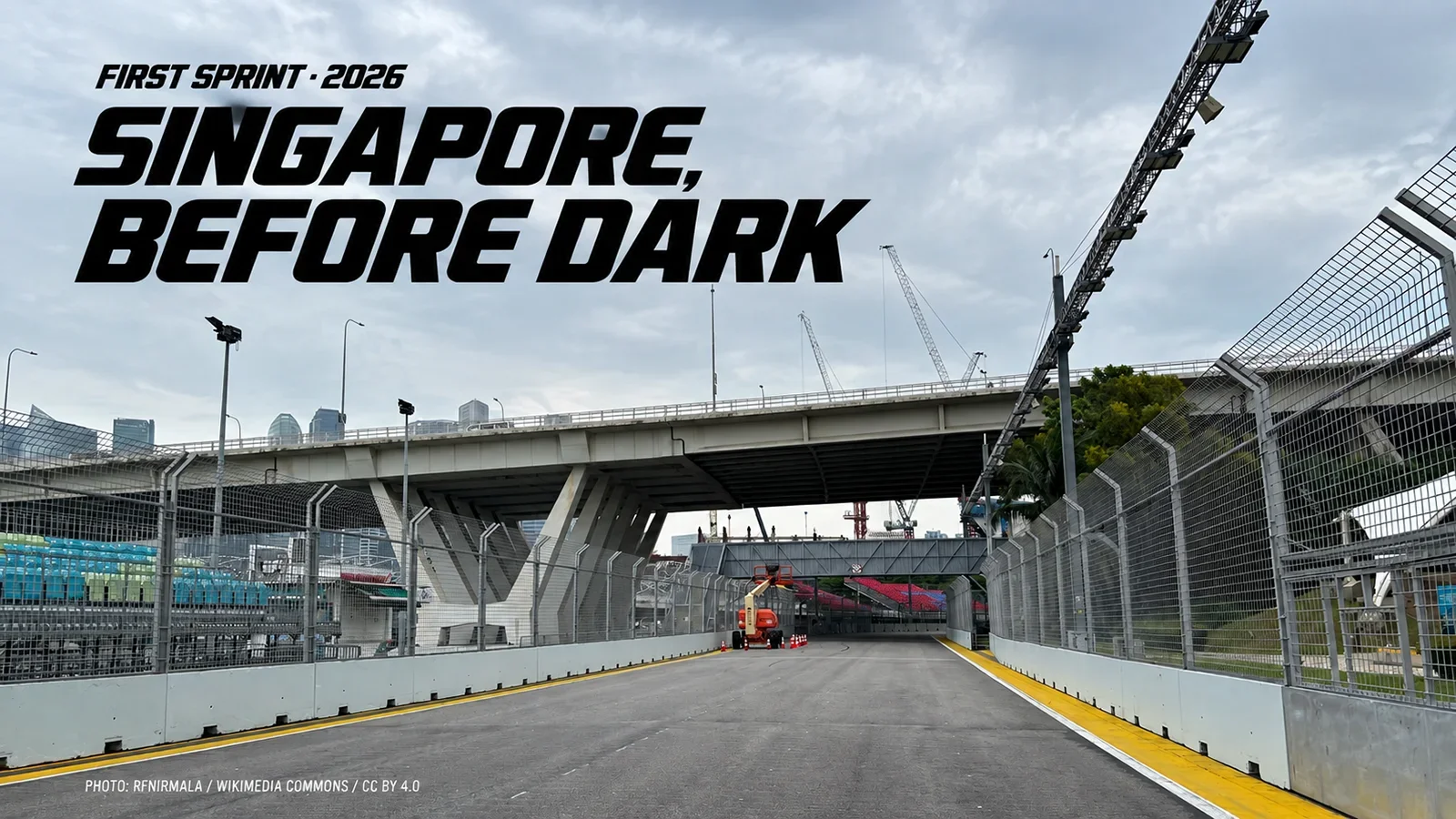
Singapore built its Formula 1 identity around racing after dark. This weekend, its first Sprint will put the circuit in a different light.
Saturday’s race starts at 5 p.m. local time on October 10, bringing daytime F1 racing to Marina Bay. Sunday’s Singapore Grand Prix remains a night race, starting at 8 p.m.
The sixth and final Sprint of 2026 adds more than another competitive session. Teams must prepare for an afternoon race while also finding the performance they need under the floodlights.
One practice session, two different settings
The only practice session runs from 4:30 to 5:30 p.m. on Friday. Sprint Qualifying follows at 8:30 p.m., with Grand Prix qualifying scheduled for 9 p.m. on Saturday.
That gives teams an hour of practice at a similar time of day to the Sprint, but no dedicated night practice before either qualifying session.
The practical challenge is deciding how much of what they learn in daylight will remain useful later. A car’s balance and tire behavior need to be assessed against the conditions in which those laps were completed, rather than assuming the same response after sunset.
Any interruption during practice would further reduce an already limited opportunity to test.
Heat remains part of the equation
In its Singapore preview, Haas highlights component cooling and rear-tire temperature management as particular demands at Marina Bay. Repeated acceleration out of slow corners puts the rear tires to work, while heavy braking adds another management task.
Haas head of car engineering Hoagy Nidd also identifies brake management as a challenge early in the race.
Daylight adds another variable, but the timetable alone cannot establish how much hotter the track will be. Cloud cover and rain could affect that comparison, and Singapore’s night sessions still bring demanding heat and humidity.
What Saturday can tell teams about Sunday
The Sprint gives teams competitive running to study before the Grand Prix. The question is how representative it will be.
A strong afternoon stint could provide useful evidence about tire behavior and consistency. It would still need to be interpreted alongside the conditions expected for Sunday evening.
For viewers, Singapore will offer a different picture. For engineers, the task is more familiar: work out which lessons to trust, with little time to find the answers.
