
FROM BAKU PODIUM TO POINTS FIGHT: WILLIAMS’ FW48 UPGRADE ARRIVES
Carlos Sainz stood on the Baku podium a year ago; now Williams returns ninth in the standings with a long-awaited FW48 package chasing points and proof that its development direction is working.
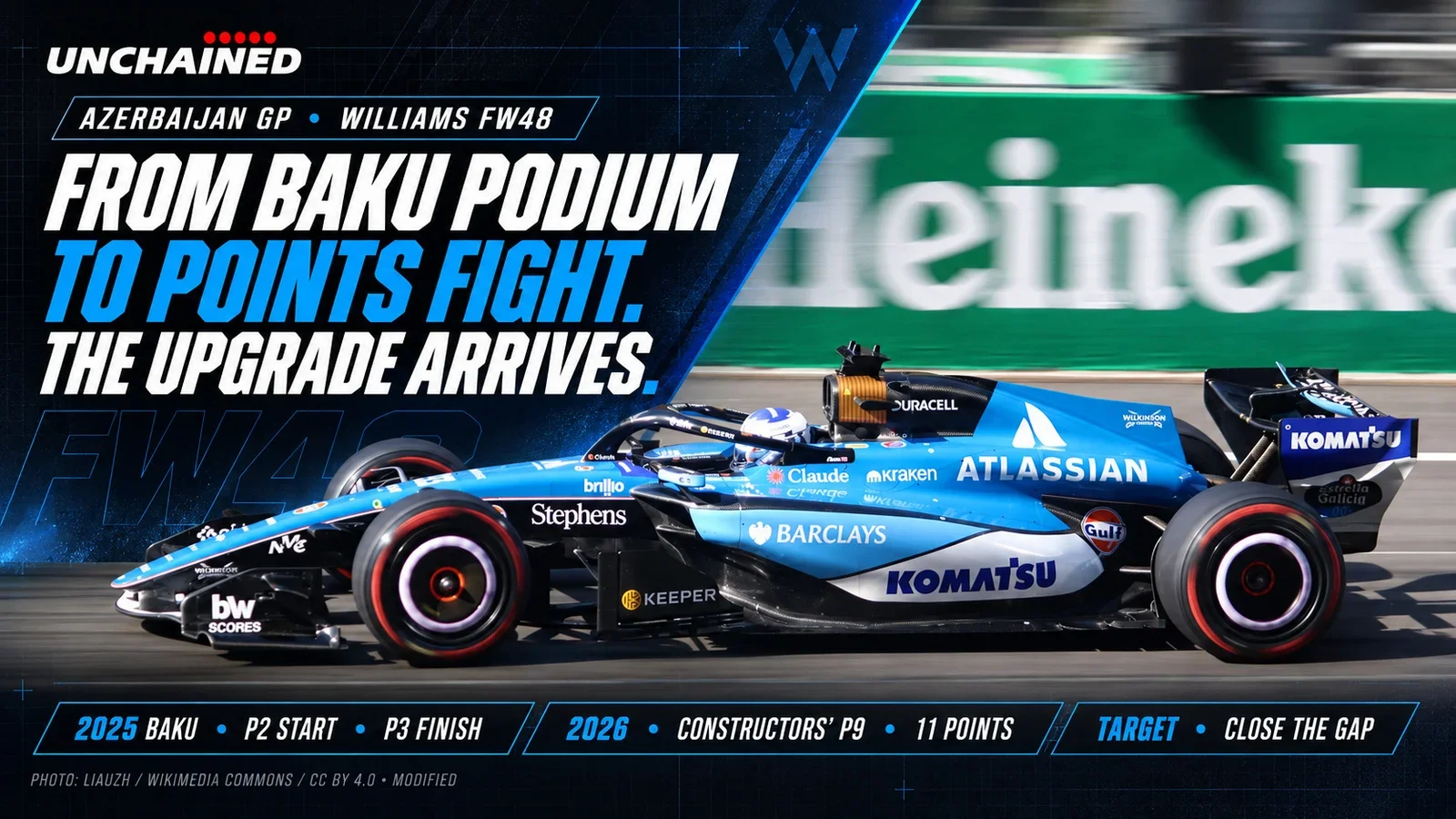
Carlos Sainz qualified second and finished third in Baku last season. When Williams returns to the same streets this weekend, the immediate target is far more modest: find a way back into the points.
The contrast captures Williams’ difficult 2026. Delays kept the FW48 out of the Barcelona shakedown, then the car arrived overweight and carrying underlying weaknesses. Williams introduced a revised front wing at Silverstone and continued removing weight, but saved its largest planned development step for Azerbaijan.
The team reaches Baku ninth in the Constructors’ Championship with 11 points, six behind Audi and 10 behind Haas. All five of its points finishes came during the opening part of the season.
The target moved while Williams waited
The challenge is not simply making the new package work. Williams must also recover ground against midfield rivals that continued improving while its upgrade moved from design to production.
Alex Albon has pointed to teams introducing three or four substantial packages during the season, with individual updates producing larger gains than Williams expected. He estimated that the FW48 recently finished approximately 50 seconds behind the midfield over a race distance, close to one second per lap.
That is why both drivers have tempered expectations. The package could move Williams closer, but Albon does not expect one update to erase the entire deficit. A development step that appeared capable of restoring the team’s competitiveness when it was planned now faces a benchmark that has moved several times.
Points matter, but confidence matters too
Sainz has described the immediate objective in similarly realistic terms. Williams hopes to return to the points fight and perhaps collect one or two, not suddenly rejoin the front of the midfield.
Baku provides a compelling setting for that test. Sainz started from the front row and converted it into third place here in 2025, but this year’s visit is about rebuilding rather than repeating that podium.
The result will matter, particularly with two teams within 10 points in the standings. The correlation between Williams’ factory predictions and the upgrade’s actual performance may matter even more.
If the expected gains appear on track, the team will have evidence that its revised tools and development methods are leading it in the right direction for the FW50. If they do not, Williams will face more difficult questions about why its simulation work is not translating successfully to the circuit.
Last year, Baku showed what Williams could achieve when the car and circuit aligned. This weekend’s target is less glamorous but arguably more important: prove that the team can still move forward while the rest of the midfield keeps moving with it.
