
Red Bull Proves Its Progress. Mercedes Finds Direction. McLaren Still Needs Pace.
PROVE IT: Singapore delivered three different answers. Red Bull’s recovery traveled, Mercedes found encouraging evidence for its upgrade, and McLaren’s stronger Sunday couldn’t hide its performance deficit.
By Miki | F1Unchained
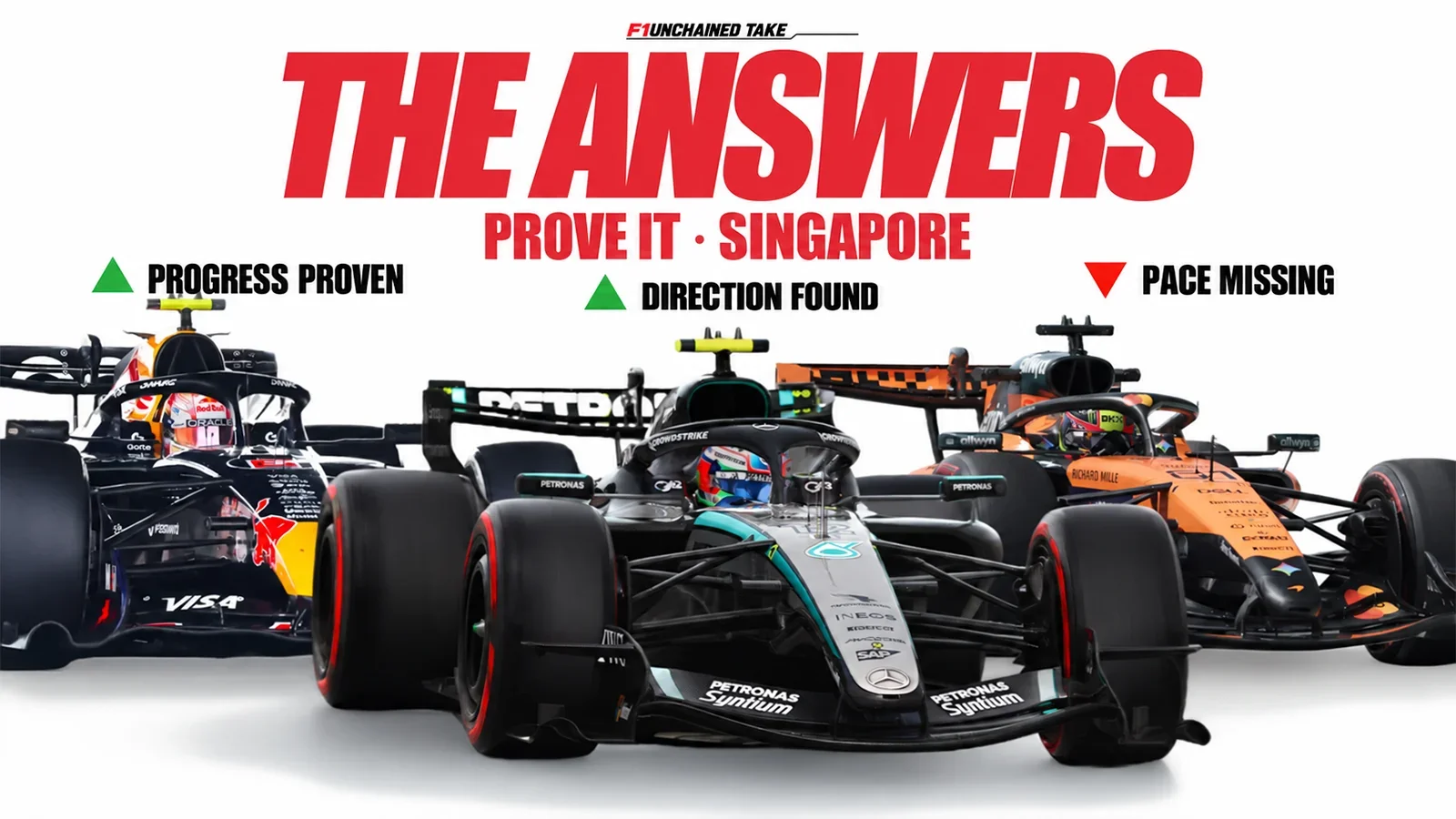
Before Singapore, we set three tests. Could Mercedes make its upgraded package work? Could Red Bull carry its Sepang recovery onto a very different circuit? Could McLaren deliver a cleaner weekend and reduce the weakness it expected Marina Bay to expose?
The point was to return to those questions after the race, using the same standards.
Singapore gave us enough evidence to make judgments. It also left limits on what we can reasonably claim.
MERCEDES: DIRECTION FOUND
Original question: Can the new front wing make the upgrade work?
Assessment: SUPPORTED, with limits.
Antonelli’s third place and Russell’s ninth were never going to settle this by themselves. Russell’s grid penalty, traffic and different race circumstances made a finishing-order comparison inadequate.
The stronger evidence came from Mercedes’ engineering assessment.
Andrew Shovlin said: “By the end of the weekend, Kimi’s package was clearly the faster of the two.”
That directly addresses the purpose of running different specifications. Mercedes reported encouraging behavior in qualifying and race conditions as it moved closer to the setup the upgraded car needed.
There are qualifications. Toto Wolff acknowledged that the package remained harder to get into its preferred setup range. Antonelli also said the car was still short of its ideal condition.
And none of those statements isolates the new front wing’s contribution from the rest of the package.
Mercedes leaves with evidence supporting its development direction. That is meaningful progress. It still has to turn that understanding into performance it can access consistently.
RED BULL: PROGRESS PROVEN
Original question: Does the recovery travel beyond Sepang?
Assessment: SUPPORTED, with incomplete evidence from the second car.
Verstappen answered the central question emphatically: pole for both races, victory in both races, and convincing Grand Prix pace at Marina Bay.
Singapore presented a different challenge from Sepang. Red Bull’s improvement survived that change.
But our original test explicitly included Hadjar. We cannot quietly discard that requirement because Verstappen won.
Mechanical problems disrupted Hadjar’s weekend and prevented a clean qualifying comparison. His recovery from a pit-lane start to tenth, supported by his positive assessment of the race pace, offered useful evidence. It did not provide the same test as an uninterrupted weekend near the front.
That distinction matters. Red Bull demonstrated that its car could deliver winning performance beyond Sepang. Hadjar’s problems also showed that giving both drivers a reliable opportunity to exploit that performance remains unfinished work.
The recovery has substance. Singapore strengthened that conclusion without proving Red Bull will now lead at every circuit.
McLAREN: PACE MISSING
Original question: Can it recover where it expects a weakness?
Assessment: CHALLENGED.
McLaren recovered points on Sunday. It did not produce convincing evidence that its underlying performance problem had been overcome.
Norris finished fourth and Piastri fifth. Both improved on their starting positions, while Piastri also had to manage an unscheduled stop after a puncture.
Those were useful results. The drivers’ explanations were more revealing.
Norris described McLaren as fourth-fastest and said the car needed more speed and more forgiving handling. Piastri likewise acknowledged that its pace was insufficient. Andrea Stella said the result reflected the car’s current performance.
Sunday therefore gave us evidence that the limitation extended beyond missed opportunities.
The cleaner-weekend test also remained unsatisfied. The Sprint collision between Norris and Piastri cost the team, and a more productive Grand Prix could not erase it.
We should still avoid claiming that Singapore conclusively isolated the slow-corner weakness identified beforehand. The public evidence supports a broader performance deficit; it does not precisely measure which characteristic caused how much of it.
WHAT SINGAPORE ANSWERED
Red Bull provided the strongest demonstration of transferable pace. Mercedes supplied a more qualified but useful answer about its upgrade. McLaren salvaged a result while acknowledging that the car needed more performance.
Those conclusions carry different levels of certainty. Treating them as equally decisive would miss the point of PROVE IT.
The next step is to see whether those findings hold at Austin: whether Mercedes can use what it learned, Red Bull can sustain its progress, and McLaren can bring a meaningful response.
Singapore has supplied the evidence. These are the judgments it supports.
— Miki
Which team’s Singapore performance changed your expectations most: Red Bull, Mercedes or McLaren?
