
How Do You Lose a World Championship by Half a Point?
Alain Prost won seven races in 1984, including the finale, but Niki Lauda’s five victories and valuable second places delivered the title, 72 points to 71.5.
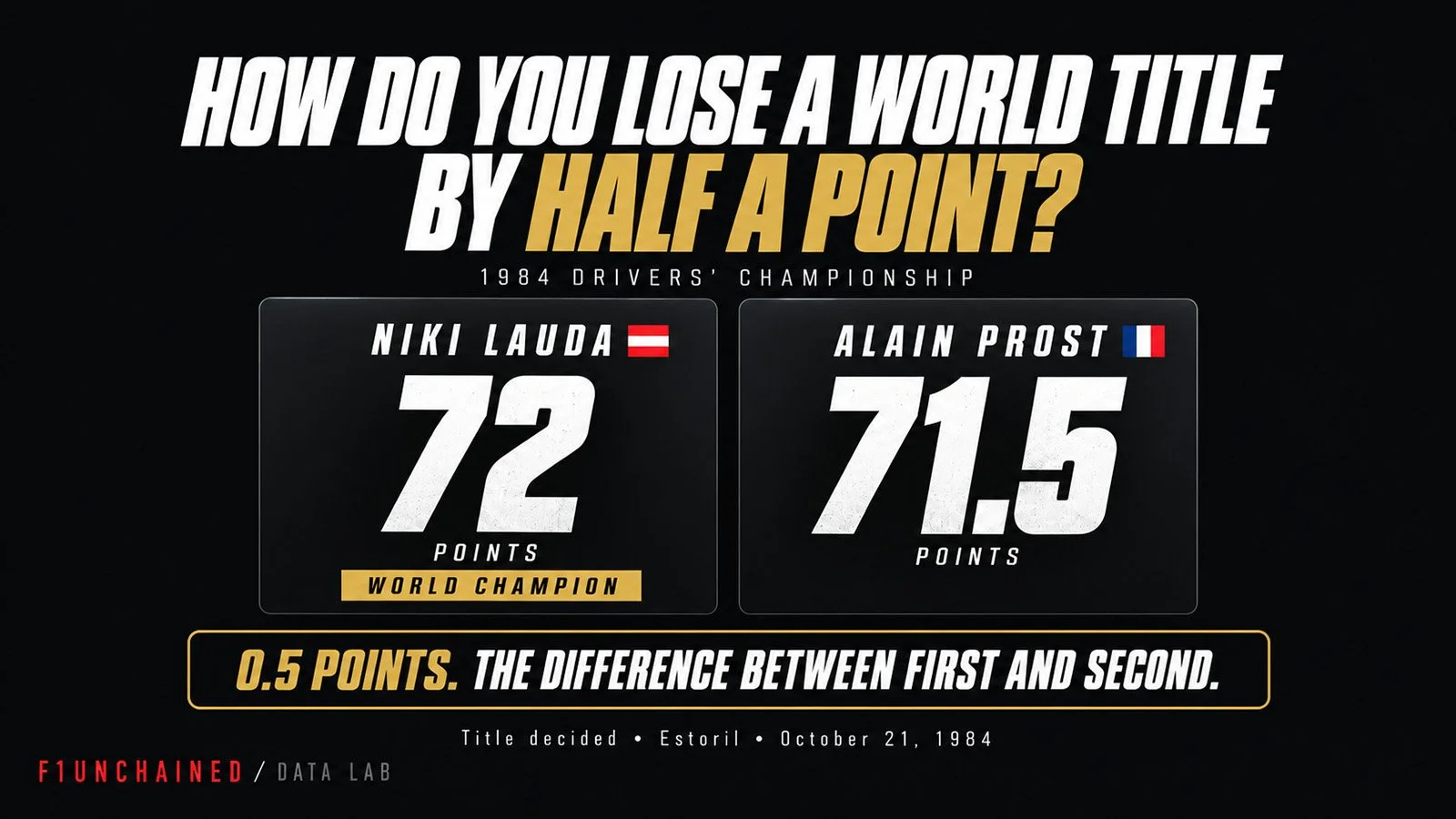
Prost crossed the finish line first at Estoril on October 21, 1984. His McLaren teammate arrived 13.425 seconds later and became world champion.
Lauda’s second place was worth six points. Prost’s victory earned nine. That three-point swing wasn’t quite enough to erase Lauda’s 3.5-point advantage entering the Portuguese Grand Prix.
The fraction had come from Monaco. Keeping it intact required Lauda to fight through the field in Portugal.
Why Monaco paid only 4.5 points
In 1984, the top six normally scored nine, six, four, three, two and one points.
Monaco was different. Heavy rain brought the race to an early end, with the official result counted over 31 laps. Because it finished short of 75% of the scheduled distance, half points were awarded.
Prost won and received 4.5 instead of nine. Ayrton Senna finished second and collected three. Lauda had retired and scored nothing.
That explains the decimal in Prost’s final total. It doesn’t establish what would have happened if the race had continued.
A second place worth full points would have earned Prost six, 1.5 more than his shortened-race victory. Holding every other result unchanged, that would have made him champion with 73 points to Lauda’s 72.
But that calculation assumes Prost finished second in a longer race. Speaking to McLaren for its 2023 retrospective, he emphasized that either he or Senna could have crashed or suffered a problem. The extra points were possible, not guaranteed.
What they needed at Estoril
Lauda arrived with 66 points to Prost’s 62.5. First or second would secure his third championship regardless of Prost’s result.
Prost needed one of three combinations:
Win, with Lauda third or lower.
Finish second, with Lauda fifth or lower.
Finish third, with Lauda outside the points.
Fourth wouldn’t be enough, even if Lauda scored nothing.
Qualifying made Lauda’s task harder. Prost started second; Lauda lined up 11th, with eight cars between them.
Prost won the race. Lauda found second.
Prost moved into the lead while Lauda worked forward through overtakes and problems for drivers ahead.
Nigel Mansell’s Lotus occupied the second place Lauda needed. When Mansell developed brake trouble, Lauda moved ahead and into the championship-winning position.
He stayed there through the finish. Prost had done everything he could by winning, but Lauda had reduced the damage to three points.
Lauda: 66 + 6 = 72.
Prost: 62.5 + 9 = 71.5.
Half a point remained.
The season behind the margin
Prost’s seven wins beat Lauda’s five. The rest of their scoring explains why the championship went the other way.
Lauda added four second places and one fourth. Alongside his seven wins, Prost scored one second place, one third and one fourth. His Monaco victory earned 4.5 points rather than nine.
Both scored in ten races. Although only a driver’s best 11 results counted that season, neither had to discard any points.
Monaco supplied the fraction, but all ten scoring results contributed to each total. At Estoril, Lauda still had to turn 11th on the grid into second at the flag to make that half-point advantage count.
