
Four seconds can feel like forever when an F1 car is sitting still. Norris, Piastri and Antonelli all had slow stops in Mexico, but the biggest pit-lane moment involved Leclerc, Verstappen and a penalty Ferrari couldn’t outrun.
An F1 pit stop is usually over before you’ve finished wondering whether something has gone wrong. In Mexico, several gave you time to ask.
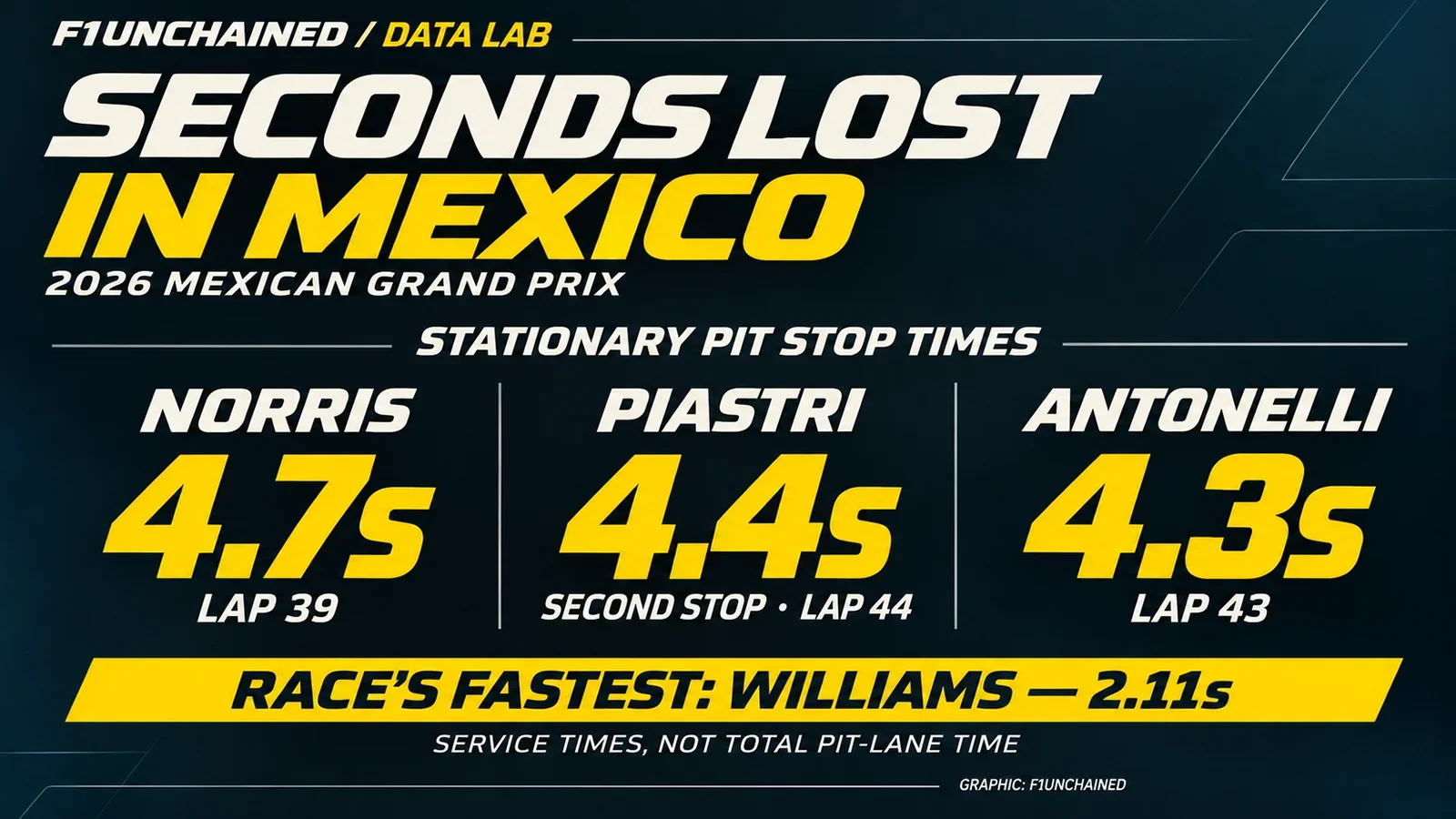
Lando Norris sat stationary for 4.7 seconds. Oscar Piastri’s second stop took 4.4. Kimi Antonelli’s took 4.3. Williams, meanwhile, produced the race’s fastest service at 2.11 seconds.
Those numbers tell part of the story. What made Mexico interesting was what happened around them: a fight for the lead, a long wait for a Safety Car and a red flag that changed the value of fresh tires.
Norris lost seconds before running out of room
Norris’s afternoon was already complicated before he reached his pit box.
He believed McLaren had the pace to challenge much further forward, but spent the opening stint behind George Russell. Stopping early offered no easy escape. According to McLaren, traffic in the window where Norris would rejoin made that option unattractive.
So he stayed out, hoping for a Safety Car or a useful tire advantage later.
When Norris finally stopped on lap 39, the service took 4.7 seconds. He rejoined fifth, with work to do.
That was a costly delay, but it would be too simple to say a quicker stop would have delivered a podium. The subsequent Safety Car closed the field, and the red flag allowed everyone to fit fresh tires. Norris’s opportunity to chase rivals on older rubber disappeared.
After the restart, his problem became familiar: he could follow Charles Leclerc, but he couldn’t get past.
Antonelli’s timing hurt as much as his stop
Antonelli stayed out even longer, making his first tire change on lap 43.
His 4.3-second stop was slow, yet he still rejoined fourth. Then Valtteri Bottas crashed, bringing out the Safety Car Antonelli had been waiting for.
It arrived just too late to help his stop.
That is the cruel part of extending a stint. The potential reward grows with every lap, but so does the risk of worn tires costing time while the hoped-for interruption never comes.
Antonelli still finished third and secured the championship. His stop was a setback within a successful afternoon, rather than the defining moment of his race.
Leclerc’s wait changed the lead
The most consequential pit-lane exchange came earlier.
Leclerc and Max Verstappen stopped together at the end of lap 27. Ferrari had to serve Leclerc’s five-second penalty before working on the car.
The official timing recorded Leclerc spending 28.706 seconds in the pit lane, compared with Verstappen’s 22.466. That is a difference of 6.240 seconds, including the penalty and everything between the timing points.
Verstappen emerged ahead.
This was more than a contest between mechanics. Red Bull had kept its driver close enough to make Ferrari’s mandatory wait count.
Russell’s later stop also included a penalty, this time ten seconds. His 33.926-second pit-lane total should therefore never be presented as a tire change that took half a minute.
The stopwatch needs context
Piastri’s two stops offered another useful contrast. McLaren reported 2.57 seconds for his first service and 4.4 for his second.
Even within one team, on one afternoon, execution varied.
Williams’s 2.11-second benchmark shows how quickly the job could be done. It does not mean every difference from that time translated directly into a position lost, or that every delay had the same cause.
Mexico’s lesson is that a pit stop has two clocks: the seconds spent stationary and the race unfolding around it.
A slow service can hurt. A penalty can surrender the lead. And a Safety Car arriving one lap too late can make the timing of the stop matter just as much as its speed.
