
BAKU’S HIDDEN TRAP: WHY THE TROUBLE STARTS BEFORE TURN 1
Baku’s two-kilometer flat-out blast can cool the tires before one of the lap’s biggest braking zones, leaving drivers to attack Turn 1 with less grip than they might expect.
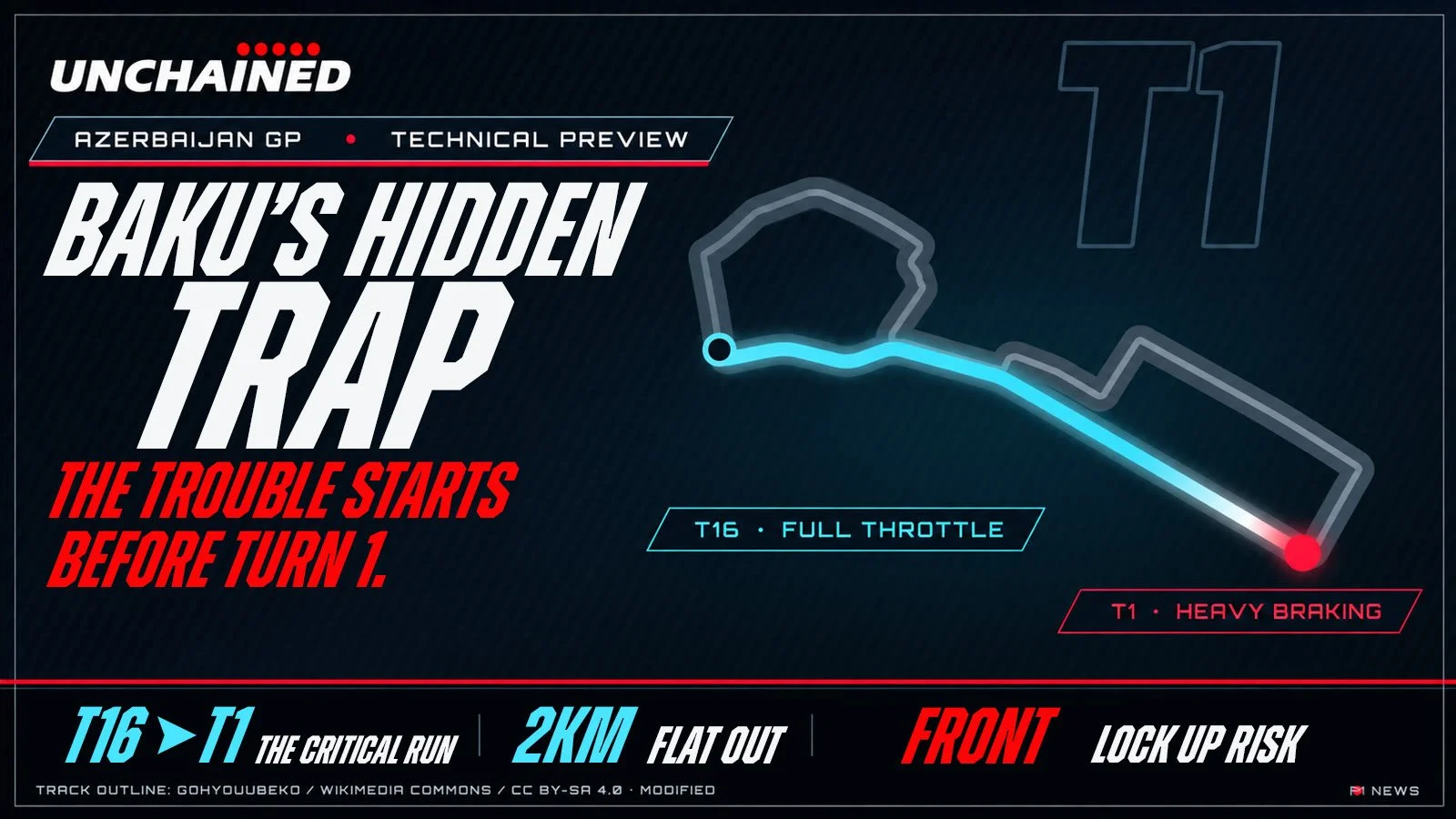
At Baku, the challenge of Turn 1 begins almost two kilometers before the driver reaches it.
From the exit of Turn 16, the cars accelerate through the final bends and remain at full throttle for roughly 25 seconds. It is one of Formula 1’s longest uninterrupted bursts of acceleration—but while the car gathers speed, the tires can move in the opposite direction.
THE STRAIGHT COOLS WHAT THE DRIVER NEEDS
With no meaningful cornering load for such a long period, tire temperatures can fall before the heavy braking zone at Turn 1. Pirelli says the cooling effect could increase the risk of front-wheel lock-ups as drivers slow the car at the end of the straight.
A lock-up occurs when a tire stops rotating while the car is still moving. That reduces grip and steering control, making it easier to overshoot the corner or run wide. At Baku, where the opening turn arrives after the fastest section of the lap, the driver must judge the braking point while accounting for tires that may no longer provide the response they had earlier in the lap.
The circuit’s smooth, relatively low-grip surface adds another complication. Williams Racing expects generating temperature in both axles to be difficult, particularly in qualifying. Buildings surrounding the track also create extensive shaded areas, allowing surface temperatures—and the car’s balance—to change during a session.
THE SAME STRETCH DRAINS THE BATTERY
Tire temperature is not the only thing drivers must manage before Turn 1.
Williams expects cars to use their full available battery window between Turn 16 and the opening corner in both qualifying and the race. That makes reaching the final section with enough stored electrical energy especially important.
Deploy too much earlier in the lap and the car may not have maximum electrical assistance for the long run to the line. Save too much and time can be lost elsewhere. Drivers and engineers therefore have to plan the lap around a section that demands speed, battery power and tire preparation at the same time.
ONE SETUP FOR TWO DIFFERENT CIRCUITS
Baku also forces teams to compromise between two very different environments. The narrow, low-speed old-city section rewards traction, braking stability and driver confidence. The long flat-out run rewards aerodynamic efficiency and low drag.
Adding downforce can help the car through the corners but increase resistance on the straight. Reducing it can improve straight-line speed while making the car more difficult to control in the slower sections and under braking.
Pirelli expects low tire degradation and considers a one-stop race the most likely outcome, although that remains a pre-race projection. The bigger tire question may be how quickly drivers can place each axle in the correct temperature window when it matters most.
Baku’s hidden trap is therefore not simply the speed reached before Turn 1. It is what that speed can take away: tire temperature, battery reserves and confidence at the moment the driver must hit the brakes hardest.
