
Interlagos will look familiar when Formula 1 arrives for the São Paulo Grand Prix, but teams have a few reasons to question their old notes. Parts of the circuit have been resurfaced, Pirelli is bringing softer tires, and this year’s conventional weekend gives everyone three practice sessions to work out what those changes mean.
The important answers will come over a run of laps. A tire that delivers immediately might become expensive to keep on the car. Another that takes longer to get working could give a driver more room to maneuver on Sunday.
The hard tire gets another chance
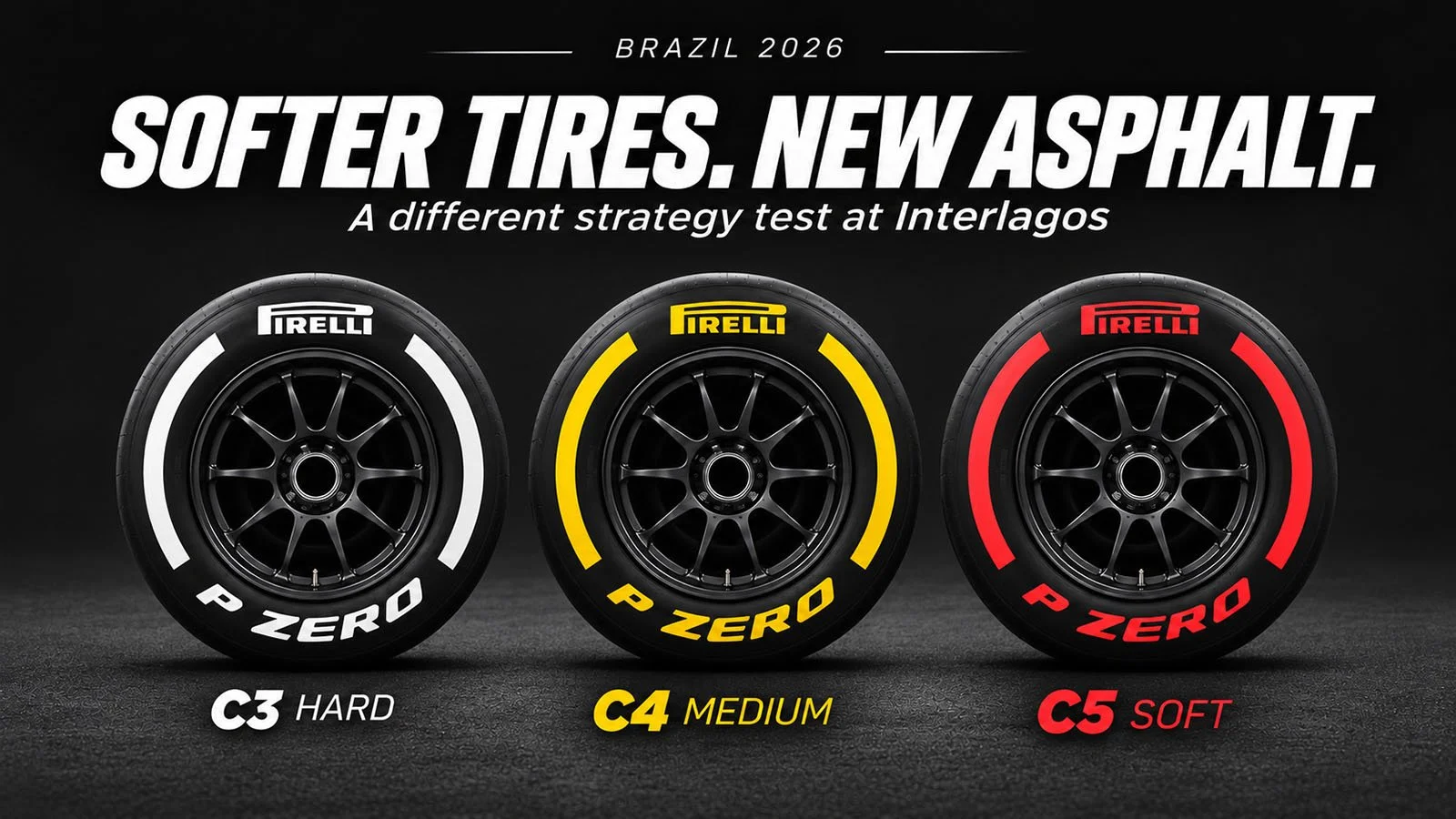
Pirelli has selected the C3 as the hard, C4 as the medium and C5 as the soft. That moves the entire selection one step softer than last year.
The change also gives the labels a useful bit of context. This weekend’s white-marked hard belongs to the compound designation used for last year’s medium. “Hard” means the hardest of the three available options, rather than one fixed tire brought to every circuit.
In 2025, teams largely built their races around the medium and soft. The hard made only brief appearances, while two stops became the most common approach.
Pirelli’s softer selection could broaden those choices. The question is whether all three compounds offer enough useful race pace to become part of a strategy, rather than leaving teams to choose mainly between two.
Fresh asphalt adds another variable
Resurfacing has taken place between Turns 3 and 5 and between Turns 8 and 9. Pirelli identifies those sections as a potential influence on grip, track evolution and tire behavior over longer runs.
That makes practice especially useful. Teams need to understand how the tires respond as the surface gains rubber and conditions change. A promising early run is only one piece of that picture.
Brazil’s return from the Sprint format provides more time to investigate. Three practice sessions allow teams to compare compounds, adjust the car and check whether an improvement over one lap also holds up over a longer stint.
What to watch before Sunday
The most revealing question is how well each tire maintains its pace. If the soft delivers competitive laps for long enough, it becomes more than a qualifying tool. If the hard offers consistent speed, it gives teams another way to approach their stops.
Those are possibilities to test, not conclusions we can draw from the allocation alone. Weather and track temperature could change the choices again.
Friday’s fastest lap will get the attention. For Sunday, watch what happens several laps into a run. That is where teams will start learning whether the new selection gives them a useful extra option—or another tire they would rather leave in the garage.
