
F1 2027 RULES: 10 SPRINTS, SHORTER GPs AND A HARD STOP
Ten Sprint weekends and a four-day preseason test are already approved for 2027, while shorter GPs and a new finishing clock now await final WMSC approval.
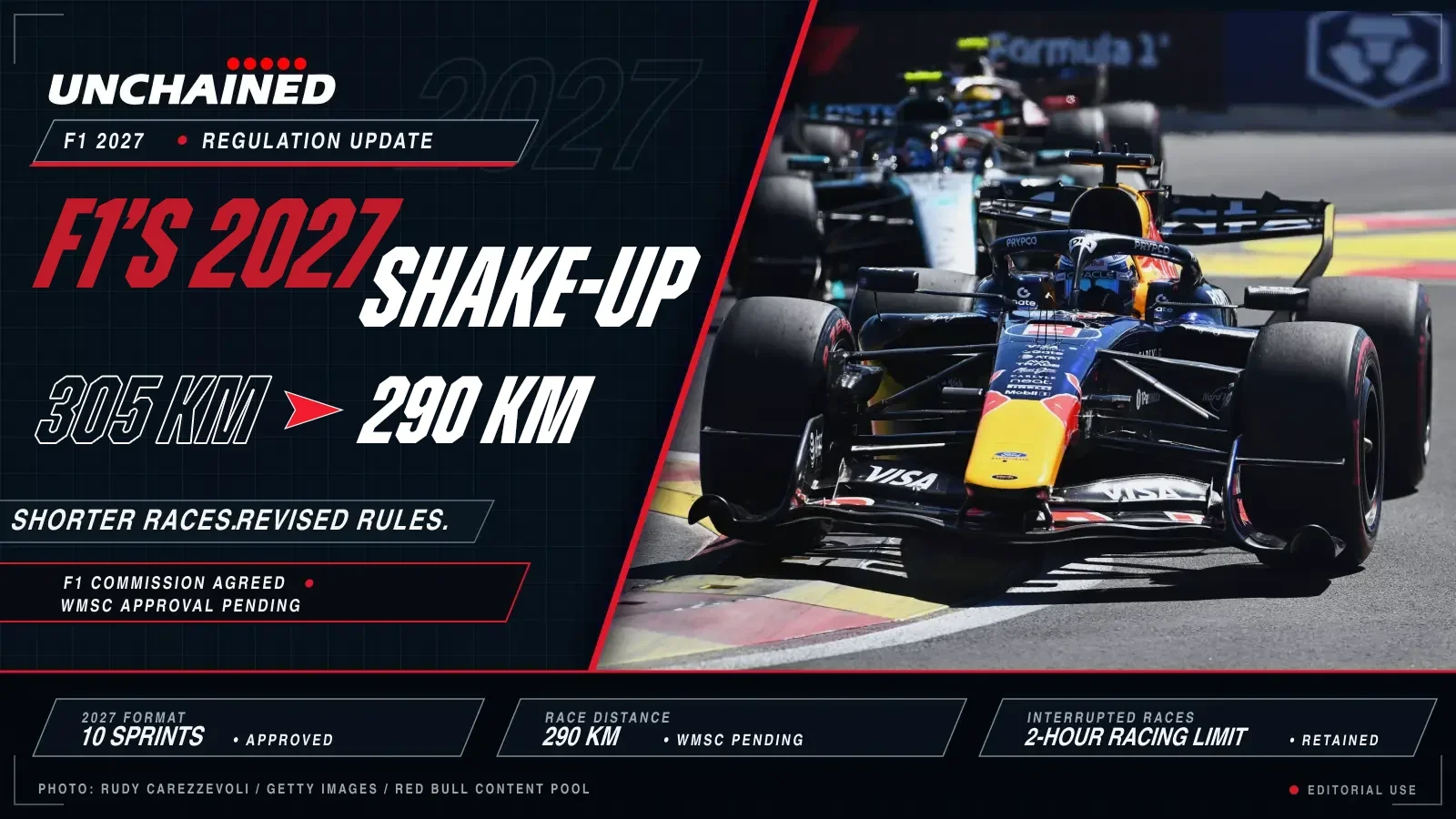
F1’S 2027 SHAKE-UP: 10 SPRINTS, SHORTER GPs AND A NEW HARD STOP
Ten Sprint weekends and a four-day preseason test are already approved for 2027, while shorter GPs and a new finishing clock now await final WMSC approval.
Formula 1’s 2027 season will look different before the cars even reach the grid. The calendar will contain more Sprint weekends, preseason testing is changing, and the latest regulatory package proposes shorter races and a new deadline for disrupted GPs.
The important distinction is that some of these changes are already approved, while others still require ratification by the FIA World Motor Sport Council.
Ten Sprint weekends are already official
The WMSC-approved 2027 calendar expands the Sprint schedule from six weekends to 10. Bahrain, Australia, Japan, Monaco and Abu Dhabi will hold their first F1 Sprints, while Canada, Great Britain, Italy, Brazil and Qatar retain or regain the format.
That means four more weekends with Sprint Qualifying and a Saturday race rather than a conventional practice-only schedule. It will be the most immediate change for viewers across the season.
Preseason testing will also be condensed into one four-day test in Bahrain. That replaces the expanded 2026 program, which included a five-day shakedown in Barcelona and two three-day Bahrain tests as teams prepared completely new cars and power units.
Why shorter GPs are now being proposed
The F1 Commission has agreed to reduce the standard race-distance threshold from 305 kilometres to 290 in 2027. The FIA expects that to remove approximately two or three laps from most GPs, but this part of the package still needs WMSC approval.
A 290-kilometre threshold would not make every race exactly 290 kilometres. Under the current system, the scheduled distance is the smallest number of complete laps required to exceed the threshold. Because every circuit has a different lap length, the resulting distance varies from one venue to another. Monaco currently has its own 260-kilometre exception, and the FIA has not yet explained how that will be treated in the final 2027 wording.
The proposed reduction is connected to power-unit changes already ratified by the WMSC. The published 2027 Technical Regulations raise the maximum fuel-energy flow from 3,000 to 3,150 megajoules per hour and revise electrical deployment and energy management.
Those electrical rules are more complicated than one headline number suggests. Standard ERS-K propulsion is limited to 300 kilowatts during Qualifying and when Overtake is not active in a race or Sprint, rising to 350 kilowatts with Overtake. The regulations also contain a 375-kilowatt absolute electrical limit. It is therefore inaccurate to describe the change as a simple fixed percentage split between combustion and electrical power.
A new clock for interrupted races
The latest proposal also replaces the current three-hour overall race limit with a hard stop for racing activity. The separate limit of two hours of actual racing will remain.
Under the present rules, time spent under a red flag can be added to the two-hour racing allowance until the event reaches three hours from its original start. The new approach would instead establish an absolute finishing deadline. The FIA says this is intended to give spectators the best possible chance of seeing a complete race after rain or another major interruption, although the exact hard-stop procedure has not yet been published.
Interrupted free practice sessions could also be extended with greater flexibility. Gearbox homologation is set to be removed, giving suppliers more freedom to continue development, while additional minor technical changes have not yet been detailed.
For now, the 10-event Sprint calendar, four-day preseason test and earlier power-unit rebalancing are approved. The 290-kilometre threshold, hard stop, practice flexibility and gearbox change remain agreed proposals awaiting WMSC approval.
