
George Russell will lose five grid places at Interlagos, but Mercedes picked this weekend for a reason. The engine change was coming. The decision was where he could fight back.
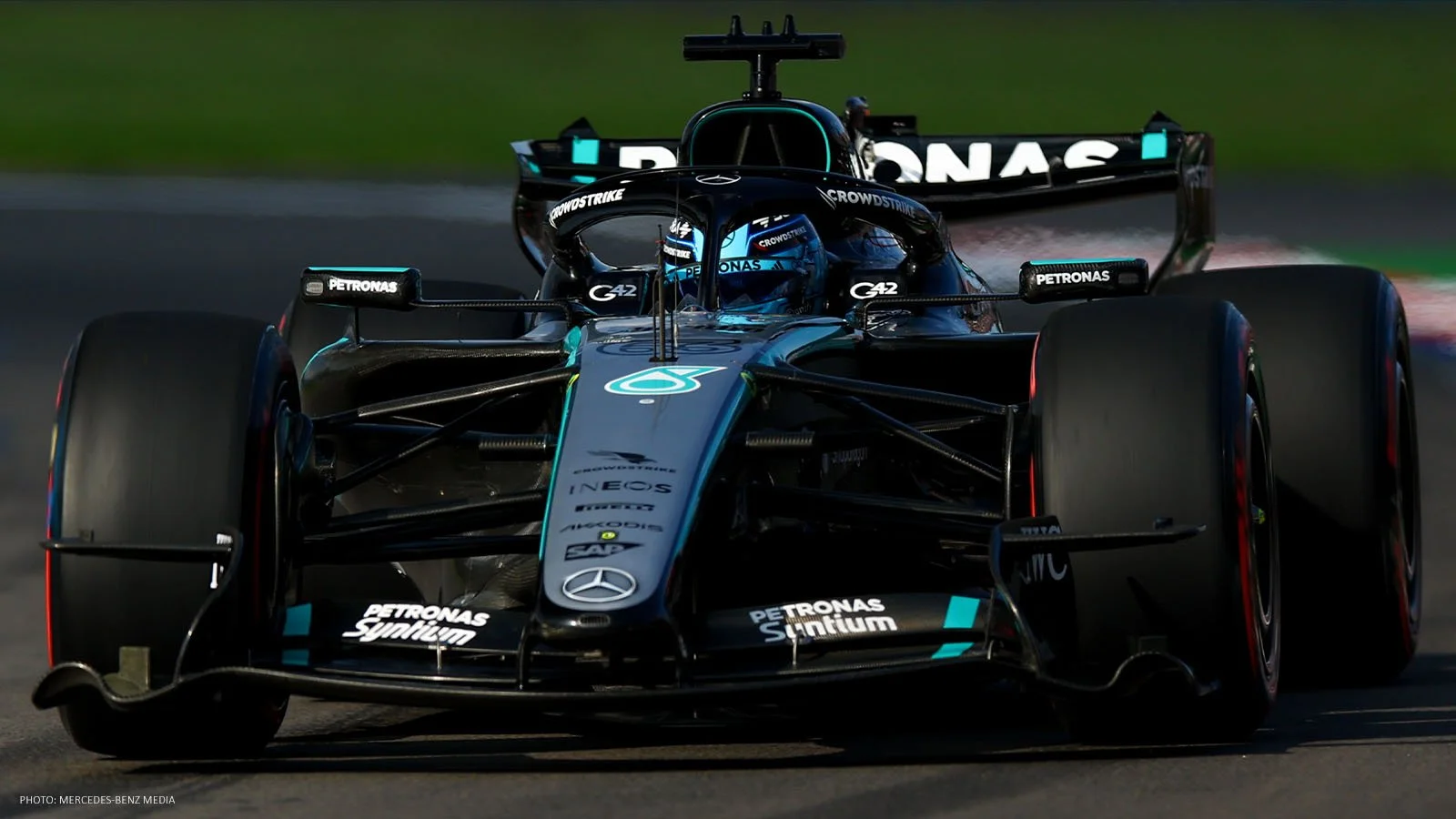
George Russell’s Brazilian Grand Prix will begin with five places to recover before he has raced a lap. Mercedes is introducing another fresh engine, accepting a grid penalty at a circuit it believes offers a reasonable chance of recovering the lost ground.
The change had been coming. Russell had already exceeded his engine allocation in Singapore, and Mercedes knew another replacement would be needed before the season ended. Interlagos became the chosen opportunity.
“Five places doesn’t seem that bad and we’ll try and come back through,” Russell said in a video shared by Mercedes.
Why take the penalty at Interlagos?
A grid penalty costs the same number of positions wherever it is served. Recovering those positions is a different matter.
Interlagos offers opportunities to attack into the Senna S at the start of the lap and again approaching Turn 4. That gives a faster car more than one place to challenge, making Brazil a more attractive option than a circuit where following another driver can consume most of the afternoon.
Russell pointed to Lewis Hamilton’s recovery here in 2021 as an example. Hamilton climbed from last to fifth in the Sprint, then won Sunday’s Grand Prix from tenth after a separate five-place engine penalty.
That was an exceptional weekend, not a forecast for Russell. But it demonstrated why Mercedes sees Interlagos as somewhere a compromised starting position can still lead to a strong result.
Why five places this time?
Russell is taking his sixth internal combustion engine of the season. He had already crossed the permitted allocation with his fifth in Singapore, so this additional replacement brings a five-place penalty.
Singapore’s much larger demotion involved several power-unit components. The Brazil change is therefore a different-sized setback, even though both weekends involve fresh machinery.
Mercedes also confirmed that this engine change does not introduce its permitted additional development upgrade. A fresh engine should not automatically be read as a new performance specification.
For Russell, it adds another complication to the Interlagos return we explored earlier this week. The immediate priority is qualifying: every position earned on Saturday still matters when five will be taken away.
Mercedes has chosen where to absorb the penalty. Russell’s task is to make that choice count.
