
F1 WANTED ZANDVOORT TO STAY. WHY IS IT ENDING?
The Dutch Grand Prix remained popular and privately funded, but its promoter chose to stop after 2026 rather than continue carrying the event’s financial risk without government support.
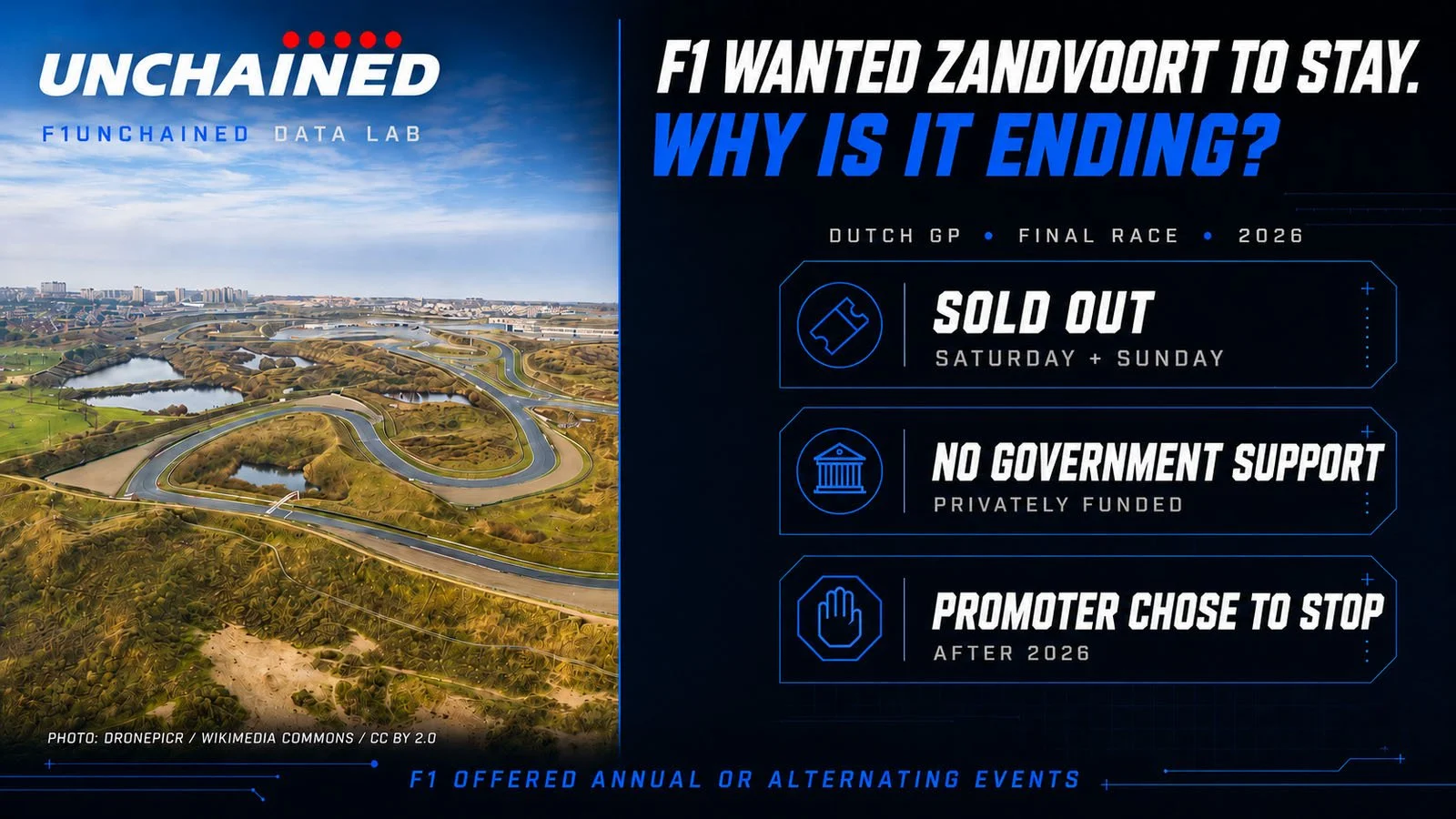
Zandvoort is closing its Formula 1 chapter while its grandstands are still full. The 2026 finale is sold out for Saturday and Sunday, yet it will end the Dutch Grand Prix’s six-race modern run.
Formula 1 did not remove Zandvoort from the calendar. It wanted the event to continue and discussed both annual and alternating arrangements with the promoter. Neither option was accepted.
SUCCESS WITHOUT A SAFETY NET
Zandvoort is one of the few Formula 1 races operating without government financial support. Its business model depends on major commercial partners and consistently selling its available tickets.
That model has worked since Formula 1 returned in 2021, but the promoter remains responsible for the bottom line. Any future decline in demand would therefore fall directly on the privately operated event.
WHY STOP WHILE IT IS STILL WORKING?
The concern was not the Dutch Grand Prix’s current popularity. It was the financial risk attached to committing to another long-term agreement and waiting until interest began to fall.
Max Verstappen’s Red Bull contract extension through 2030 reduced one concern surrounding the event’s future appeal. It did not remove the wider possibility of market saturation or softer demand over another contract cycle.
The promoter instead chose to control the timing of its departure and finish while the event remained successful.
F1 OFFERED A WAY FORWARD
Formula 1 explored more than one solution. Continuing every season and alternating Zandvoort with another race were both considered.
The promoter still decided that ending after 2026 was the better business decision. That distinction matters: Zandvoort was not rejected by Formula 1, and it was not abandoned by its supporters.
SOLD OUT—THEN GONE
The final Dutch Grand Prix will include Zandvoort’s first Formula 1 Sprint, with Saturday and Sunday already sold out.
It represents a rare departure from the calendar: a popular race voluntarily ending on its organiser’s terms rather than continuing until its commercial strength begins to decline.
