
Baku Unchained Verdict: Red Bull’s Teamwork, Russell’s Nerve, Alpine’s Disaster
Russell held his nerve, Red Bull turned teamwork into two podiums, and Alpine destroyed its own double-points opportunity. My verdict on who delivered in Baku—and who let it slip.
By Miki | F1Unchained
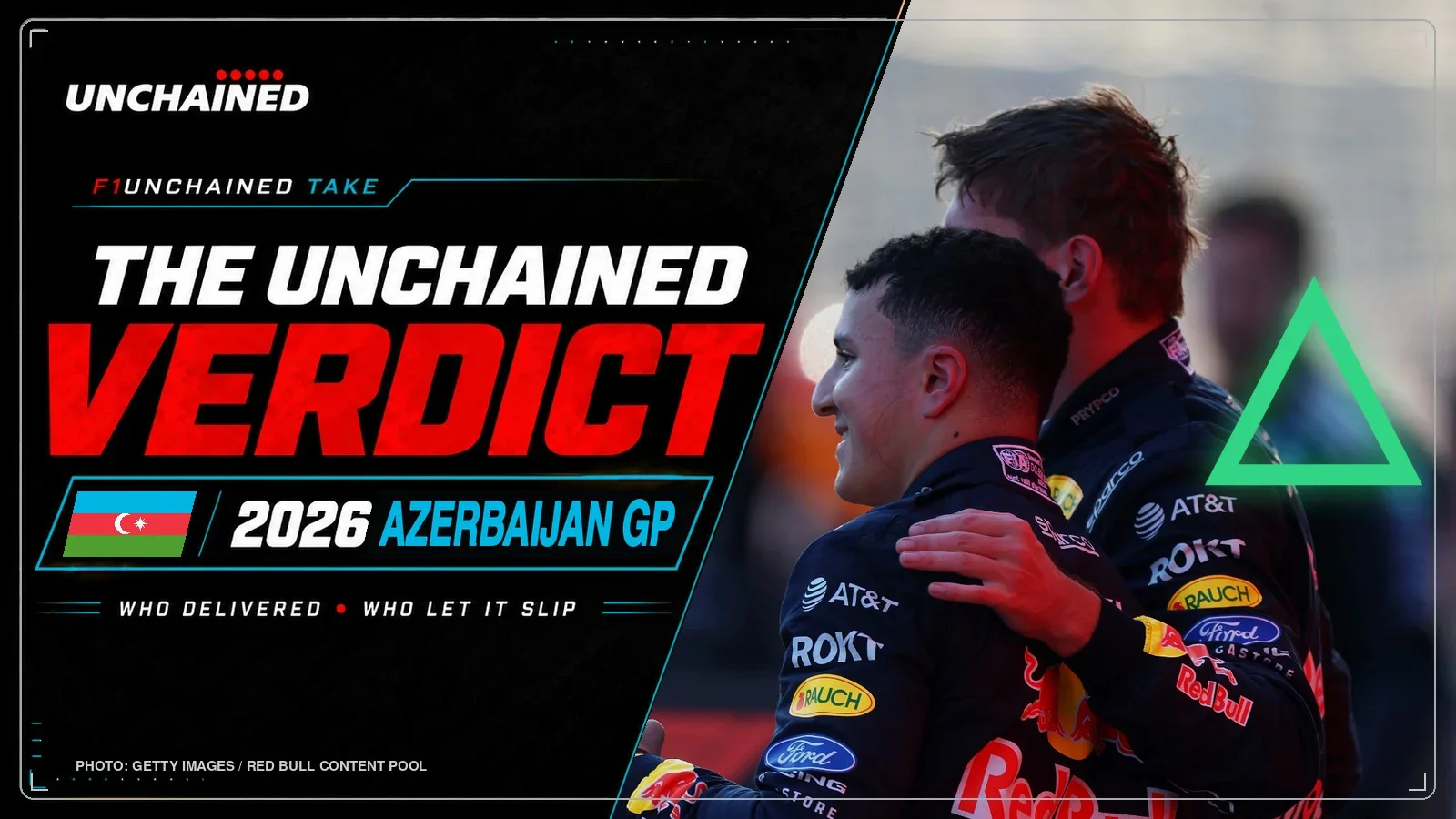
Baku did what Baku usually does. It gave the drivers time to settle into the race, then changed everything through mistakes, Safety Cars and one final push to the line.
George Russell won by 0.196 seconds. Max Verstappen went from eighth to second. Isack Hadjar returned after missing three races and completed Red Bull’s first double podium in more than two years.
Behind them, Alpine went from having both cars in the points to losing both in one incident. Oscar Piastri threw away a potential podium, Alex Albon put Williams’ updated car into the barrier, and Aston Martin could not keep either car running.
This was not simply a race of winners and losers. It was a test of execution. Some teams managed the pressure. Others created their own problems or lacked the reliability to stay in the fight.
DELIVERED
RED BULL RACING
Red Bull’s drivers delivered the positions, but the pit wall deserves the first verdict.
Hadjar started fourth on the soft tyres and showed the stronger first-stint pace. He recovered from losing places at the start, passed Charles Leclerc and then allowed Verstappen through so Max could attack Piastri.
When Verstappen began struggling for grip on the mediums and Hadjar closed back in, Red Bull resisted the temptation to keep changing the order. The team held its position, kept both drivers in the race and waited for the Safety Car it believed was likely to arrive.
It did.
Red Bull then executed the double-stack stop cleanly, put Verstappen onto the faster soft tyre and maintained Hadjar’s track position on the mediums. Verstappen took second from Piastri at the restart, while Hadjar secured third.
Laurent Mekies said the strategy gave Red Bull its best opportunity to challenge Piastri and Russell. That does not make it the only possible approach, but it explains the logic.
I call it great strategy because Red Bull committed to a team plan, both drivers respected it and the crew executed when the opportunity arrived. The result was P2 and P3, achieved without sacrificing either car while chasing the win.
That was teamwork.
MAX VERSTAPPEN
This was classic Max.
Starting eighth after a difficult qualifying session, Verstappen immediately began working his way through the field. He cleared Gasly, Hamilton and Leclerc, then moved ahead of Hadjar to begin the chase after Piastri.
The medium tyre never gave him the grip or confidence he wanted, but he kept the car in position until the first Safety Car opened the pit window. Once Red Bull put him on the softs, the race changed.
Verstappen passed Piastri at the restart and spent the final stint applying constant pressure to Russell. The gap generally stayed around one second, close enough to punish any mistake but not close enough to launch a clean move.
The timing screen made the finish look even more dramatic. Russell lost power response after lifting for the late yellow flags, allowing Verstappen to close rapidly on the run to the line. That compressed the final margin to 0.196 seconds.
Red Bull had genuine pace in Baku, so this was not another case of Max dragging an uncompetitive car beyond its level. The car belonged near the front.
What Verstappen did was turn eighth on the grid into a sustained fight for victory and make Russell earn every part of it.
GEORGE RUSSELL
Russell controlled this race from pole, even when Baku repeatedly erased the advantage he had built.
He opened a comfortable lead during the first stint and managed the race from the front. Albon’s crash wiped that gap away. Colapinto’s accident created another Safety Car. Each time, Russell had to restart with Verstappen and the Red Bulls ready to attack.
He handled both restarts.
The final stint demanded something different. Russell could no longer manage a comfortable lead. Verstappen stayed close enough to keep the pressure on, and both drivers pushed hard enough to brush the barriers without ending their races.
Russell did not fold. Even when the late yellow flags left him without immediate power response and Verstappen appeared alongside near the finish, he had done enough to keep the Mercedes ahead.
His victory reduced Kimi Antonelli’s championship advantage from 81 points to 66. Antonelli still leads with 302, but Russell is now on 236 and has kept the fight alive.
This was the composed, decisive Russell Mercedes needed. He took pole, controlled the race and delivered when the pressure was at its highest.
ISACK HADJAR
Hadjar missed three consecutive race weekends, returned on one of the least forgiving circuits on the calendar and immediately finished on the podium.
That is an exceptional comeback.
He started fourth, recovered from losing ground at the start and showed real pace on the soft tyres. His passes on Norris and Leclerc placed him in the fight at the front, while his disciplined response to Red Bull’s strategy helped the team manage both cars as one unit.
Hadjar stayed close to Verstappen during the first stint, handled the restarts and brought the car home third despite a late warning about gearbox vibrations. His pace was strong, but the maturity of the drive mattered just as much.
The stewards later gave him a warning over a pre-race practice-start procedure infringement. It did not change the result, but it belongs on the record.
Hadjar’s race itself was measured, composed and exactly what Red Bull needed. His podium completed the team’s first double top-three finish since the 2024 Chinese Grand Prix.
Six weeks away. One weekend back. Straight onto the podium.
ESTEBAN OCON
The retirements ahead created the opening, but opportunities do not convert themselves.
Ocon survived the restart chaos, kept the Haas out of trouble and finished eighth. Oliver Bearman followed him home in ninth, giving the team six points and its first double-points result of the season.
Haas did not begin the weekend looking like a team ready to leave with one of its strongest results. Even the team admitted it benefited from the incidents ahead.
That does not reduce what Ocon and Bearman achieved. When Alpine eliminated both of its cars and Piastri dropped down the order, Haas was ready to take the positions.
Ocon brought the result home. Bearman completed the job behind him. Haas took the chance others threw away.
LET IT SLIP
ASTON MARTIN
This was a weekend write-off.
Both Aston Martins started at the back after taking power-unit penalties. Neither reached half distance. Neither scored a point.
Stroll completed seven laps before a water-pressure issue forced the team to stop the car. Alonso lasted 20 laps, but worsening straight-line performance led Aston Martin to retire him with suspected power-unit trouble.
These were not driver crashes, and the criticism should not pretend otherwise. The drivers did not throw the cars away.
The problem is that Aston Martin lacked the pace to fight its way forward and then lacked the reliability to finish. Mike Krack admitted there was not much available based on the team’s performance around Baku, even before both cars retired.
Slow and unreliable is the worst combination a team can bring to a Grand Prix.
There is no softer verdict available. Aston Martin left Baku with nothing.
FRANCO COLAPINTO
Alpine had both cars inside the points when the first Safety Car came out. Seconds after the restart, both were effectively out of the race.
Colapinto arrived at Turn 1 with cold tyres and brakes, locked up and hit teammate Pierre Gasly. Gasly was pushed into Norris, eliminating all three cars and triggering another Safety Car.
One mistake destroyed Alpine’s double-points opportunity and ended Norris’ race with it.
Colapinto apologized immediately and accepted responsibility. That matters, but it does not reduce the size of the error. The stewards gave him a 10-second penalty that he could not serve, converting it into a five-place grid penalty for his next race.
This was not a small misjudgment with a minor consequence. Alpine had done the difficult part. Both drivers were in position to score.
Colapinto threw all of it away at Turn 1.
OSCAR PIASTRI
Piastri’s race was not poor from beginning to end. That is what makes the final result more frustrating.
He started third, moved into second at the start and spent the opening stint defending intelligently against a faster Verstappen. For much of the afternoon, a podium was there.
The first restart exposed how difficult the medium tyres were to bring into the right operating window. Verstappen passed him, but Piastri remained third and still had a strong result available.
Then came the second restart.
Piastri locked the front tyres at Turn 1, ran into the escape area and had to turn the car around as the field went past. Flat-spotted tyres left him with no realistic recovery, and he finished 13th in the final classification.
McLaren left Baku with zero points.
The car had limitations on the straights, and the medium tyres gave Piastri less confidence than the softs. Both are fair context. Neither changes the decisive moment.
The opportunity was there. The execution failed when it mattered most.
ALEX ALBON
Albon’s race ended after he had completed 29 laps, when a lock-up sent the Williams into the barrier and brought out the first Safety Car.
He explained that he braked slightly later than on the previous lap and was caught by a large gust of wind. He expected to run wide, not hit the wall.
That explains how quickly the accident developed. It does not recover the result.
Williams brought an important update to Baku and believed it had moved the car into the midfield fight. Albon lost the chance to turn that progress into points by leaving no margin when the conditions changed.
Carlos Sainz eventually salvaged tenth place and one point for the team. Albon left Williams to wonder what its second car could have added.
Baku punishes small errors with large consequences. Albon made one and lost the rest of his race.
THE FINAL VERDICT
Not every Baku setback belonged in the same category.
Aston Martin retired both cars mechanically. Piastri ran wide rather than crashing. Russell and Verstappen both brushed the barriers while fighting for the victory and continued. Albon’s accident ended his own race, while Colapinto’s mistake destroyed the afternoon for three drivers and turned Alpine’s double-points opportunity into a double DNF.
The difference was execution.
Russell controlled the race, handled two restarts and kept his nerve when Verstappen filled his mirrors. Red Bull managed two different tyre strategies, kept its drivers working together and converted that discipline into two podiums. Hadjar delivered a mature comeback, while Haas stayed ready and collected six points when the race opened up around it.
Alpine did the hard work and then lost everything in one braking zone. Piastri had a podium within reach and failed to complete the race that his opening stint had created. Albon put an updated Williams into the wall. Aston Martin never had the reliability to remain involved.
Baku did not reward perfection. Nobody produced that.
It rewarded the teams and drivers who kept their mistakes small enough to survive.
Russell did. Red Bull did. Haas did.
Others let the opportunity slip.
— Miki
What’s your take: was Red Bull’s teamwork the strongest delivery in Baku, or did Russell’s control under pressure deserve the top verdict?
Respectful disagreement is welcome; personal attacks, abuse and spam will be removed.
