
Norris Was Right to Be Angry. Wrong to Demand a Ban.
Lando Norris had every reason to be furious after Franco Colapinto ended his race in Baku, but anger alone cannot set the standard for a Formula 1 suspension.
By Miki | F1Unchained
Update: September 28, 2026
Lando Norris has now publicly confirmed that he apologized to Franco Colapinto for his comments after Baku. He acknowledged that emotions were no excuse and that he should not have said what he did. I said in this article that I like Lando and have huge respect for him. Taking responsibility like this reinforces that respect. I still disagree with the call for a ban, and I give him credit for owning his words and apologizing.
Latest development: Norris Owns His Baku Comments: “It Was Wrong of Me”
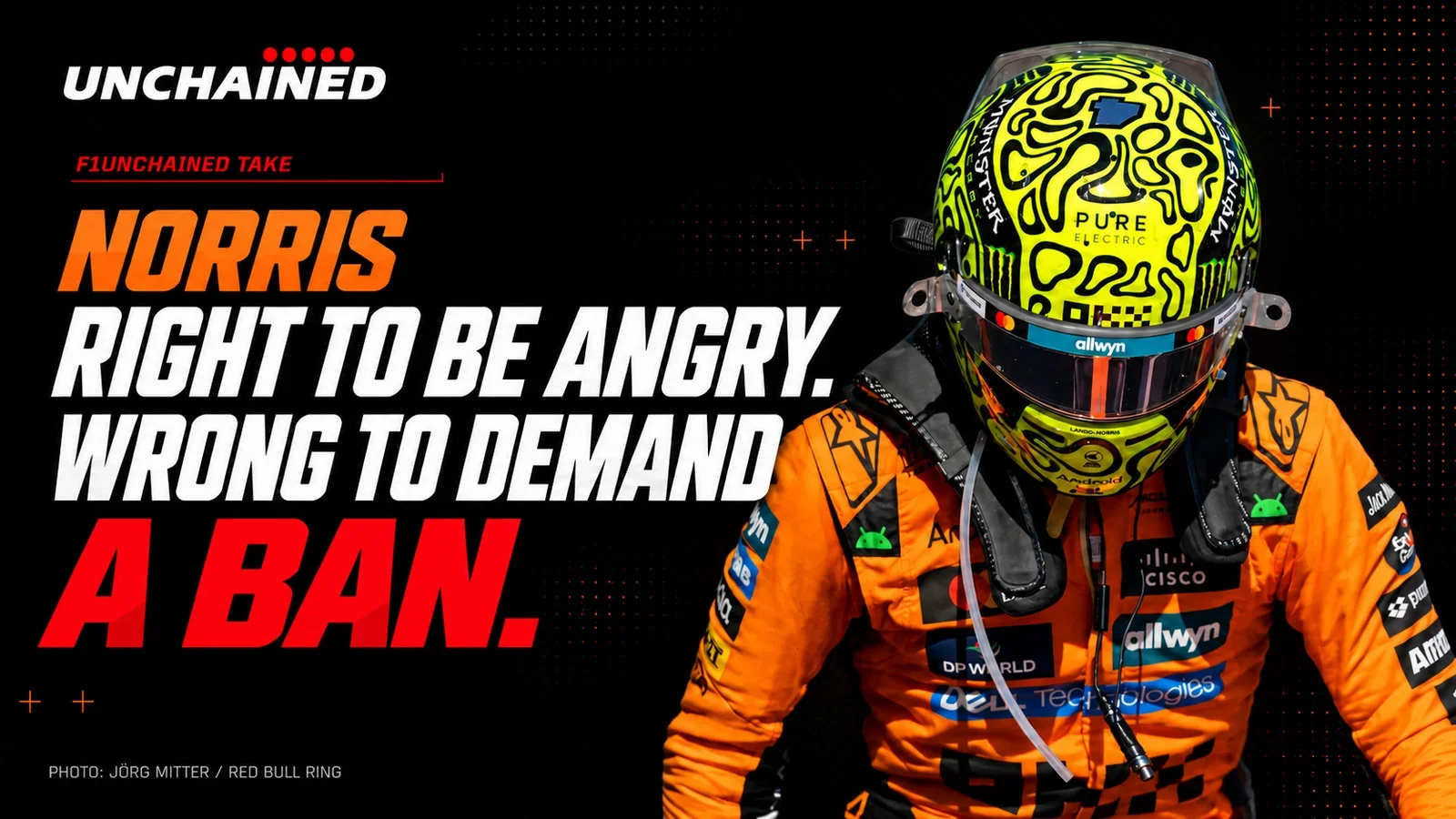
Norris had every right to be furious
I like Lando, and I have huge respect for him. I understand why he was furious. But I don’t agree that Franco Colapinto’s mistake in Baku deserved a race ban.
Norris was an innocent passenger in somebody else’s accident. At the first Safety Car restart on lap 36, Colapinto misjudged his braking into Turn 1 and hit his Alpine teammate Pierre Gasly. Gasly was then pushed into Norris. All three drivers retired.
That’s not a minor inconvenience. Norris lost a possible points finish, McLaren was left with a damaged car and expensive parts, and there was absolutely nothing he could do to avoid the impact.
He had every right to criticize Colapinto. He had every right to call the driving careless. He didn’t have to offer a diplomatic answer minutes after climbing out of a wrecked car.
But Norris went further. While speaking to the written media, and acknowledging that he had not yet watched the incident back, he called for “at least a one-race ban.”
That’s where he lost me.
Colapinto made a serious mistake
Let’s not soften what happened.
Colapinto approached Turn 1 too quickly, braked too late and put himself in a position from which he could no longer make the corner under control. The stewards found him responsible for the collision.
He ruined Gasly’s race, ended Norris’s afternoon and destroyed Alpine’s opportunity to score points with both cars. It was an especially painful mistake because Gasly was his teammate and Alpine had two cars inside the top 10.
Colapinto admitted what he had done and apologized to Gasly, Norris, Alpine and the people working at the factory. That matters. Taking responsibility is always better than searching for somebody else to blame.
It does not erase the mistake.
Cold tires and cold brakes help explain why the lock-up happened, but they don’t excuse arriving at Turn 1 without enough control. Every driver faced the same difficult restart conditions. Colapinto was responsible for judging them properly, and he failed.
He deserved to be punished. He was.
The standard 10-second penalty for causing a collision was converted into a five-place grid penalty for his next race because he had already retired and could not serve it in Baku.
We can debate whether five grid places are enough for an error with consequences this large. What we cannot say is that Colapinto escaped without a sanction.
The argument is not punishment versus no punishment. It is whether the punishment should extend to removing him from an entire Grand Prix.
For me, that would be excessive.
Russell, Verstappen and Hadjar all thought a ban was too harsh
George Russell, Max Verstappen and Isack Hadjar each considered a race ban excessive.
They pointed to the difficulty of generating tire temperature behind the Safety Car, the low grip away from the racing line and how one misjudgment can produce enormous consequences at a circuit like Baku.
Their opinions do not settle the case. Drivers are not the stewards, and agreement among the three podium finishers does not make Norris’s anger invalid.
But their perspective is useful. They saw an unacceptable mistake, not evidence that Colapinto should be temporarily excluded from Formula 1.
Russell said he personally believes race bans should be reserved for intentional, dangerous or reckless behavior. That is his standard, not an official legal threshold. Intent cannot be the only consideration because an accidental action can still be extraordinarily dangerous.
Still, there must be a meaningful distinction between a driver making a costly braking error and a driver behaving in a way that requires the sport’s most severe immediate punishment.
The result of an error matters, but it cannot be the only factor used to determine the penalty.
If Colapinto had made exactly the same braking mistake and narrowly missed Gasly, his driving would not suddenly have become acceptable. Equally, the fact that three cars retired does not automatically turn the incident into conduct deserving a suspension.
Responsibility, seriousness and context all matter.
I don’t think Colapinto crossed the line that should result in a race ban.
Accountability must still be proportionate
Colapinto needs to learn from this. An apology cannot become a substitute for better judgment, and Alpine is entitled to demand that this kind of error is not repeated.
But one damaging lock-up should not automatically become a declaration that a driver does not belong in Formula 1.
Norris was right to be angry. He was right to make clear how much Colapinto’s mistake cost McLaren. He was also speaking in the immediate aftermath of having his race taken away through no fault of his own.
That explains the reaction. It does not make the proposed punishment proportionate.
Give Colapinto the penalty. Make him carry the competitive consequence into the next race. Judge him firmly if the mistakes become a pattern.
For this incident, though, a five-place grid drop is punishment. A race ban would be overreach.
— Miki
What’s your take: did Colapinto’s Baku mistake deserve a race ban, or was the five-place grid penalty the more proportionate response?
Respectful disagreement is welcome; personal attacks, abuse and spam will be removed.
