
SIX DUTCH GPs. SIX POINTS FINISHES. ONLY FERNANDO ALONSO.
Six modern Dutch Grands Prix. Six points finishes. My take on why Alonso’s latest P18-to-P9 recovery says more than the record alone.
By Miki | F1Unchained
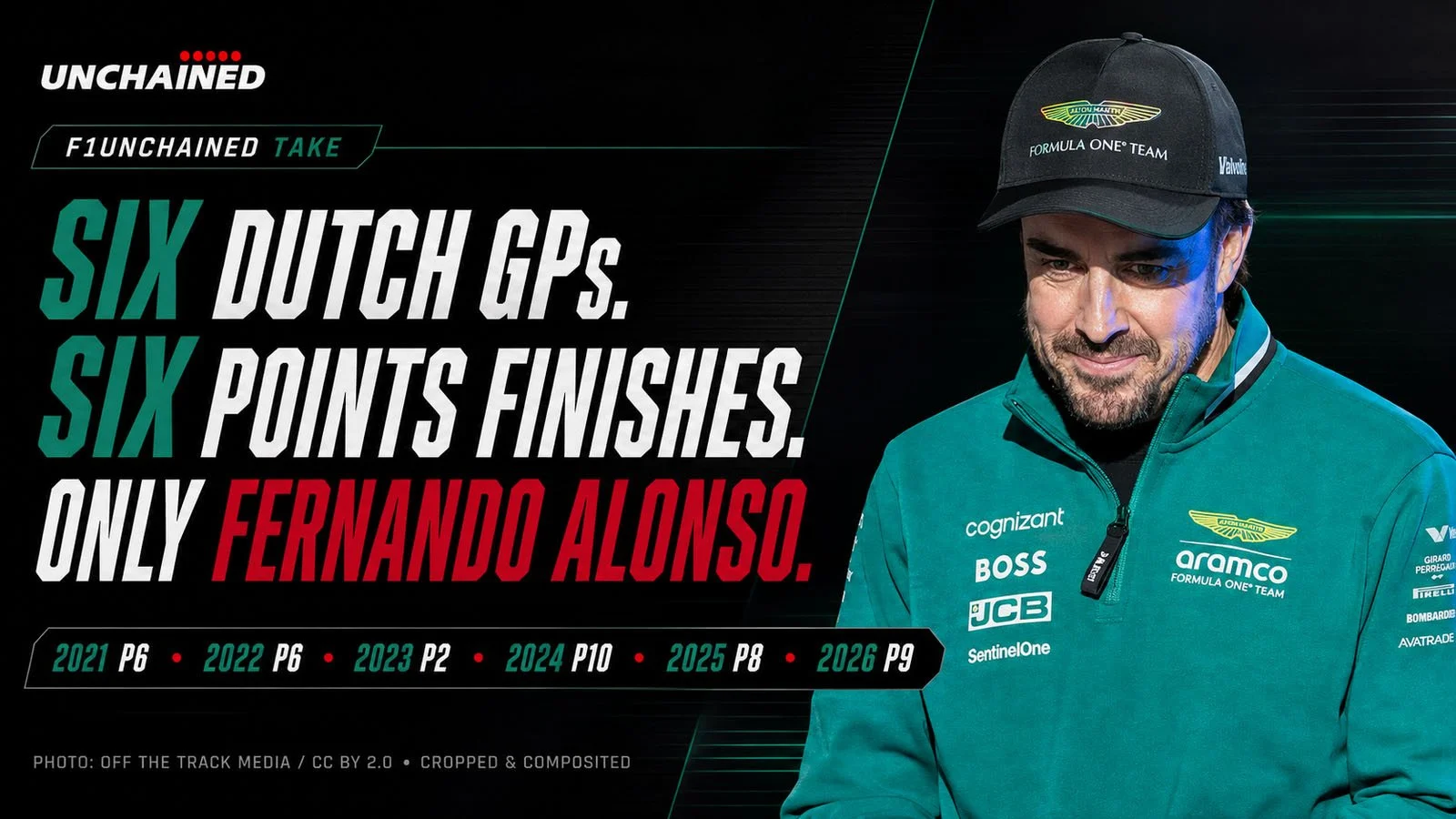
When Formula 1 returned to Zandvoort in 2021, Fernando Alonso finished sixth. He repeated that result in 2022, took second in 2023, then added P10, P8 and P9 across the following three races.
Six Dutch Grands Prix. Six points finishes. No other driver managed it.
The record spans two teams, cars with very different levels of performance and races demanding different solutions. The finishing positions changed, but Alonso’s ability to convert an opportunity into points did not.
For me, his 2026 recovery was the drive that explained the entire streak.
WHY P18 TO P9 MATTERED
Aston Martin entered Sunday in a difficult position. Alonso had qualified 18th, and the AMR26 had not shown enough straight-line performance to recover through conventional overtaking alone.
After the first-lap red flag, Aston Martin fitted him with fresh soft tyres. Alonso extended that stint while others stopped, gradually moved through the field and reached P8 before making his only conventional racing stop on Lap 34.
That created a de facto one-stop strategy. He then completed a 37-lap final stint on hard tyres and defended ninth place to the finish.
P9 does not look spectacular without context. The execution does.
Aston Martin created the opportunity, but Alonso still had to make it work. He managed the softs for almost half the race, protected the hards across the final stint and held his position when pressure arrived late in the Grand Prix.
USING EXPERIENCE TO WORK AROUND THE CAR
This was not a case of Aston Martin suddenly becoming a front-running team. The chassis upgrades represented progress, but Alonso remained cautious when assessing the updated Honda power unit.
He identified continuing problems with drivability, downshifts and engine braking. He also explained that the car was comparatively stronger through the corners but slower on the straights, making it difficult to attack while trapped in traffic.
That limitation helps explain why Aston Martin moved away from its original two-stop plan. Running longer allowed Alonso to escape traffic and use the car’s cornering performance in clear air.
At 45, experience is often used as a vague compliment. At Zandvoort, we could see what it contributed: tyre management, an understanding of the car’s strengths and the discipline to complete an unconventional strategy.
A driver cannot create performance that the car does not possess. But when a narrow route to points exists, Alonso remains one of the best at recognising it and following it to the finish.
THE FINAL TAKE
Zandvoort’s modern Formula 1 chapter ended with Alonso holding a record nobody else could match:
P6 in 2021. P6 in 2022. P2 in 2023. P10 in 2024. P8 in 2025. P9 in 2026.
Different seasons, different cars and different challenges—but points every time.
The 2026 recovery captured why. Alonso did not need the fastest car or the most obvious strategy. He needed one realistic opportunity, and when Aston Martin created it, he delivered.
At 45, the most impressive thing is not simply that Fernando Alonso is still racing.
It is that he can still change the result.
— Miki
What’s your take: was Alonso’s P18-to-P9 recovery his most impressive Zandvoort drive, or does the 2023 podium still stand above it?
Respectful disagreement is welcome; personal attacks, abuse and spam will be removed.
