
Malaysia Forever
Formula 1’s return to Sepang delivered one of the best weekends of 2026, and it was the circuit, not a gimmick, that made it.
By Miki | F1Unchained
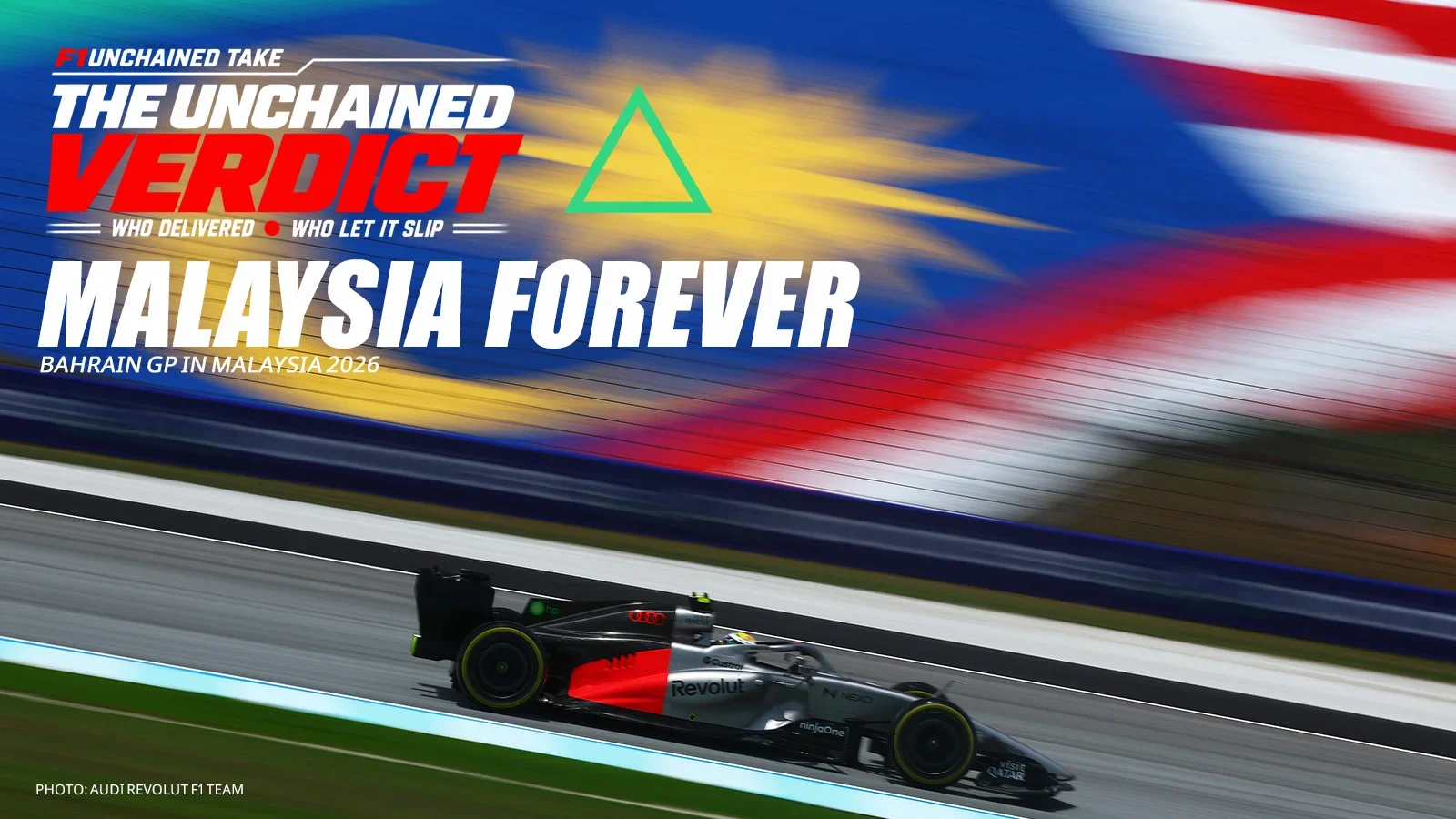
Sepang still has it.
Formula 1 raced at the Sepang International Circuit for the first time since 2017, and the place immediately reminded us why it had been missed. Wide asphalt, long braking zones and corners that actually invite a fight. Drivers could run side by side, switch lines and attempt an over-and-under without the circuit immediately squeezing them into single file.
Modern Formula 1 cars need tracks like this. Sepang offers room, but it still punishes mistakes. It tests traction out of the slower corners, stability through the fast sections, braking confidence and energy management across a long lap in brutal conditions.
When the car is only half right, the driver still has an opportunity to make the difference. That is why the entire weekend felt alive. Qualifying and the race were the standouts, but even practice carried some uncertainty because the circuit continued asking questions.
The race itself was chaos with a point. A tropical downpour delayed the start, while software-related failures during the formation laps forced the start procedure to be abandoned and reset. That technical mess deserves scrutiny. It was not part of what made the weekend great.
Once the racing began, however, Sepang delivered. The wet-to-dry crossover reshuffled the order, Safety Cars changed the strategic picture and drivers had opportunities to recover through actual racing. Calls made on the pit wall were exposed immediately. Drivers who understood the grip and could pass when the window opened were rewarded.
DELIVERED
Fernando Alonso
Fernando Alonso turned a difficult afternoon into Aston Martin’s best result of the season.
He qualified and started 12th, began the race on slick tires and initially paid the price as the intermediate runners moved forward. Safety Cars helped bring him back into contention, but Alonso still had to use the opportunity.
He made the passes, managed the changing conditions and held off Lando Norris at the end. Alonso finished eighth, 13.372 seconds behind Verstappen and only 0.621 seconds ahead of Norris.
The late compression means that final gap should not be treated as proof that Aston Martin suddenly had Red Bull-level pace. It did not. This was a driver maximizing a chance when the race came back toward him.
Four points may not sound dramatic, but for this Aston Martin season, P8 mattered.
Lewis Hamilton
Lewis Hamilton started second and fell as low as 18th after Ferrari’s slick-tire gamble went badly wrong on a track that remained too wet.
From there, the race came back toward him. The Safety Cars helped reduce the damage, and George Russell’s retirement opened the final podium position. Those circumstances have to be acknowledged.
Hamilton still had to do something with them.
He worked his way through the field, stayed in the fight and passed Isack Hadjar after the late restart to secure third place. It was not a podium produced entirely by raw pace, but it was not handed to him either.
Ferrari made the wrong initial call. Hamilton recovered from it with patience, speed and decisive racing when the opportunity arrived.
Max Verstappen
Max Verstappen was the strongest combination of driver and car when the race settled down.
He took his first pole position of 2026 with a 1:35.130 and converted it into his first victory of the season. The beginning was not straightforward. Both Mercedes drivers passed him at the initial standing start, and Red Bull then had to choose the right tire at the right moment.
Once Verstappen moved onto the softs, the race changed. He cleared Russell and Antonelli, controlled the restarts and had enough pace to keep Antonelli behind after the final Safety Car.
The winning margin was 2.307 seconds, but the performance was more convincing than that number suggests. Verstappen and Red Bull handled the changing conditions better than anyone else and finished the job.
On this day, they were the strongest package.
Liam Lawson
Liam Lawson described it as one of the best starts of his career, and it looked like one.
Starting 11th on intermediates, he launched himself into the leading fight and was challenging Verstappen for third before the order began to settle. Racing Bulls had a strong midfield car at Sepang, and Lawson used it properly.
He did not waste time fighting cars that were clearly out of position after the strategy swings. He managed his race, stayed at the front of the midfield and finished seventh.
That is what good execution looks like. The car gave him something to work with, and Lawson delivered the result it deserved.
Arvid Lindblad
Arvid Lindblad started last after power-unit penalties and still brought home the final point.
His race was not one long charge from the back. He had already run inside the top ten earlier in the afternoon before strategy and tire degradation pushed him back to 11th.
What mattered was how he responded.
On the final lap, Lindblad passed Nico Hülkenberg to reclaim tenth place and complete a double-points result for Racing Bulls. He dealt with changing conditions, multiple Safety Cars and constant midfield traffic without allowing the race to get away from him.
From last on the grid to P10, with the decisive move coming on the final lap. That was a result earned all the way to the flag.
LET IT SLIP
Williams
Williams had an opportunity and watched it disappear.
The team made the correct opening call by putting both cars on intermediates. Carlos Sainz climbed from 13th to sixth, while Alex Albon went from 18th to seventh on the opening racing lap. Both cars were suddenly in position to score meaningful points.
From there, the afternoon unraveled.
The double-stack cost Albon ground. He then reported braking problems before a gearbox issue ended his race. Sainz was hit by Gabriel Bortoleto at the first restart and spun down the order, eventually finishing 17th.
Neither driver deserves blame for the main events that destroyed the result. Williams also acknowledged that it lacked the pace it needed once the race settled down.
Still, going from two cars inside the top seven to one retirement and P17 represents a major lost opportunity. The initial decision was excellent. The final result was nothing.
Valtteri Bottas
Valtteri Bottas qualified 21st and started 19th, so Cadillac was already facing a difficult race.
Starting on soft tires while the track remained wet made the challenge even greater. Bottas tried to stay with the pack, took too much risk and spun into the gravel at Turn 13, bringing out the first Safety Car.
He admitted afterward that it was his mistake and apologized to the team.
The conditions were difficult and Cadillac’s tire gamble did not work, but Bottas still had responsibility for keeping the car out of trouble. He did not, and his race ended after only seven completed laps.
Lando Norris
Lando Norris qualified sixth and started fifth after the grid penalty ahead, but neither McLaren nor Norris converted that position into a strong result.
The decision to begin on medium tires did not work. Norris struggled for grip while the intermediate runners moved forward, and McLaren did not have the pace to fight the leading teams once the race developed.
Norris also made his own costly mistake. As the field bunched following Russell’s stoppage, he was caught out behind the Safety Car and ran through the gravel at Turn 1. He accepted responsibility for the error.
That distinction matters. McLaren’s lack of speed was a team problem. The Safety Car mistake belonged to Norris.
Oscar Piastri finished sixth. Norris recovered to ninth, but that was still a poor return from fifth on the grid.
Gabriel Bortoleto
Gabriel Bortoleto started tenth and finished 18th after compromising both his race and Carlos Sainz’s.
At the first restart, Bortoleto attempted to move inside Sainz at Turn 2 and made contact with the Williams. Sainz was spun around, while Bortoleto damaged his own car and received a ten-second penalty.
Bortoleto apologized, which was the right response. It does not erase the mistake.
Sepang gives drivers opportunities to attack, but having room to attempt a pass does not remove the responsibility to complete it cleanly. Bortoleto had a top-ten starting position and a chance to score. Instead, both he and Sainz finished near the back.
THE FINAL VERDICT
The software failure that disrupted the start was unacceptable, but it should not be confused with the quality of the circuit.
Once the race finally began, Sepang gave Formula 1 exactly what too many modern venues struggle to provide: space to race without removing the consequences of getting it wrong.
Verstappen and Red Bull executed best. Hamilton turned a disastrous opening decision into a podium. Alonso extracted Aston Martin’s best finish of the season. Lawson and Lindblad gave Racing Bulls a deserved double-points result.
Williams lost a major opportunity through a combination of execution, pace and reliability. Bottas made a mistake he immediately owned. Norris and McLaren both fell short, for different reasons. Bortoleto attempted a pass and failed to complete it cleanly.
But the biggest winner was Sepang.
For me, this was one of the best weekends of the 2026 season. The weather added uncertainty, but the circuit created the racing. That distinction matters.
Formula 1 does not need to manufacture excitement when it visits tracks capable of producing it naturally.
Bring Sepang back, and this time, keep it.
— Miki
What’s your take: should Sepang have a permanent place on the Formula 1 calendar?
Respectful disagreement is welcome; personal attacks, abuse and spam will be removed.
