
What Counts as Success for a Midfield Driver When Podiums Aren’t Realistic?
Podiums may be unrealistic, but midfield drivers still face a demanding standard: recognize the opportunity, execute cleanly and take the result the car and race actually make possible.
By Miki | F1Unchained
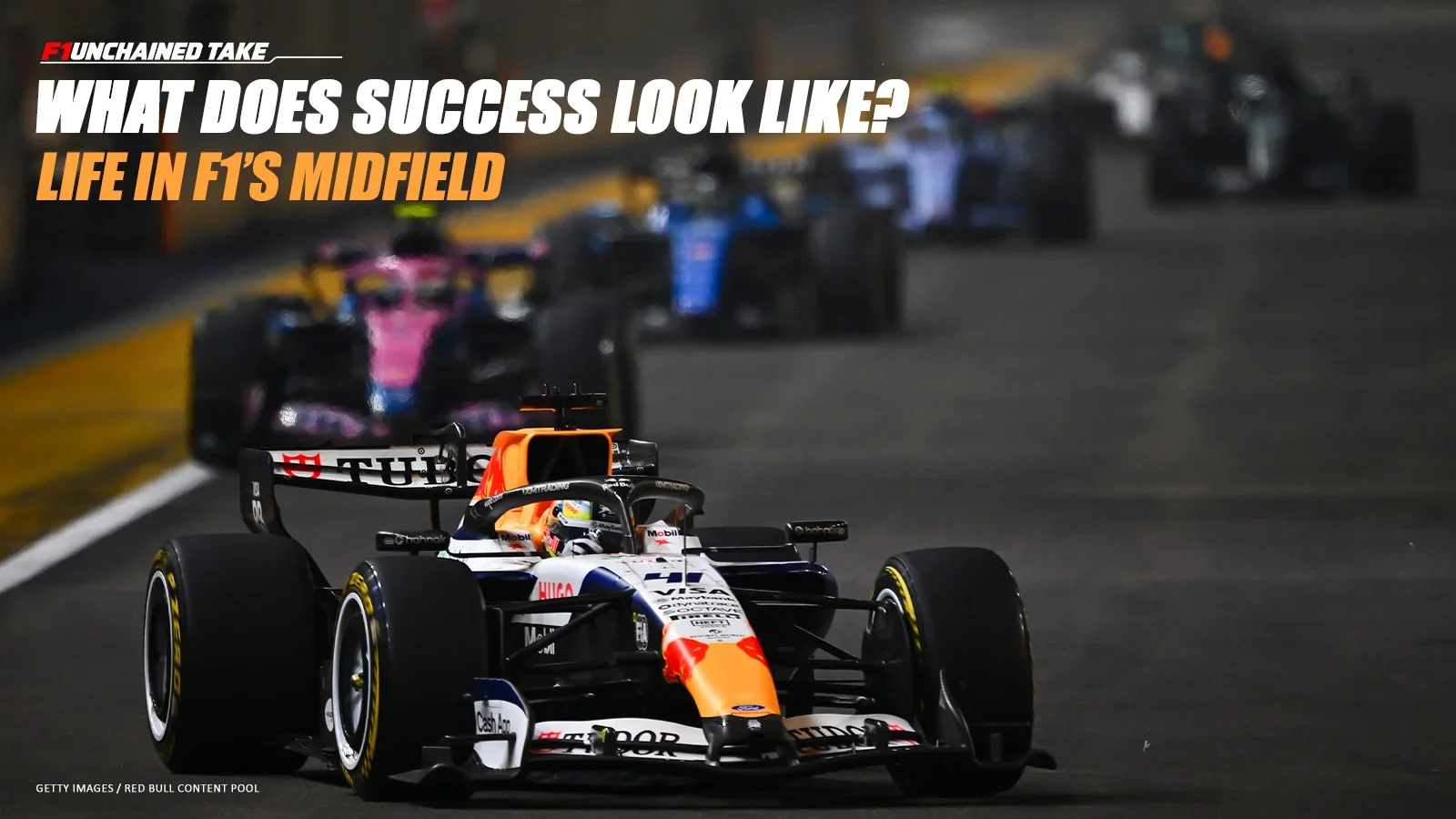
Formula 1 makes success look simple.
Win the race. Finish on the podium. Score the most points.
That standard works when a driver has machinery capable of fighting at the front. It becomes far less useful when the realistic target is seventh, 10th or sometimes just reaching Q2.
A midfield driver can produce an excellent performance and finish outside the points. Another can benefit from retirements, Safety Cars and mistakes ahead to leave with six points after an imperfect race.
That doesn’t mean finishing position should be ignored. Results matter. The mistake is treating the result as the entire judgment.
For me, the fairest question is this: What opportunity did the car and the race actually offer, and what did the driver do with it?
CONVERTING THE OPPORTUNITY
Arvid Lindblad’s race at Sepang is a good place to begin.
He started the Bahrain Grand Prix in Malaysia from 22nd after receiving penalties for new power-unit components. Racing Bulls put him on intermediate tires for the wet start, and the decision worked immediately. Lindblad climbed to ninth on the opening lap while several drivers struggled on slicks.
That was partly strategy and partly circumstance. Safety Cars reshaped the field. George Russell retired late. Lando Norris ran off the track behind the Safety Car. Those events helped create the opportunity.
Lindblad still had to convert it.
He dealt with greater tire degradation than teammate Liam Lawson, stayed close enough to the points and passed Nico Hülkenberg on the final lap to take 10th. It was only one point, but that point required the right tire choice, the right calls from the team and a decisive move from the driver.
I would not call that proof that Lindblad somehow dragged a 22nd-place car into the points. His grid position was caused by penalties, not a true measure of the Racing Bulls’ pace. Lawson finished seventh in the same race.
What Lindblad did was recognize an unexpected opening and complete the job. In the midfield, that counts.
Haas provided another example in Baku. Esteban Ocon and Oliver Bearman benefited from incidents and mistakes ahead, but they also avoided the restart chaos, managed their tires and finished eighth and ninth.
Fortune opened the door. Haas walked through it.
POINTS DO NOT ERASE THE MISTAKE
Lindblad’s own Baku race shows why the analysis cannot stop at the points table.
He finished seventh, passed Bearman and beat Ocon to the line by just 0.030 seconds. On the surface, it was another strong midfield result.
It was not a clean performance.
At the first Safety Car restart, Lindblad made contact with Lawson and sent his teammate spinning. Lawson’s floor was damaged, and he eventually finished 12th. Lindblad continued in the points and apologized to Lawson and the team afterward.
Both parts of that race matter.
Ignoring the late passes and six points would be unfair. Ignoring the contact because Lindblad finished seventh would be just as misleading.
This is where midfield evaluation becomes more demanding than reading the classification. Lindblad brought home an important result for Racing Bulls, but he also contributed to the team losing a possible double-points finish.
Success cannot mean that every mistake disappears as soon as points are scored.
A TEAMMATE IS EVIDENCE, NOT A VERDICT
The teammate comparison is one of the most useful measures available because both drivers operate within the same organization.
It is also one of the easiest to misuse.
At Singapore, Lawson and Lindblad both reached Q3. They qualified ninth and 10th before George Russell’s penalty moved them forward on the starting grid. That suggested the Racing Bulls had the pace to fight near the front of the midfield.
Lawson converted it.
He made a strong start, maintained competitive pace and passed Hülkenberg on his way to seventh. It was his second consecutive P7 finish after producing the same result at Sepang.
Lindblad finished 15th. He admitted that his poor start set the tone for his race. He also had to take evasive action at Turn 1, while the two Racing Bulls began on different tires and followed different strategies.
Those details matter, but they do not erase the central judgment. Lawson made better use of the opportunity Singapore offered.
That does not settle which driver is better. One weekend cannot do that.
Teammates can receive different upgrades, suffer different reliability problems or have their races altered by traffic and strategy. Even identical cars are not guaranteed identical circumstances.
The comparison becomes meaningful when the pattern continues across several weekends. One qualifying defeat means little. Regularly losing the same comparison without a clear explanation means much more.
CONSISTENCY IS THE SEPARATOR
One surprising points finish can be built on timing and fortune. Repeatedly converting opportunities is much harder to dismiss.
Lawson’s consecutive seventh places at Sepang and Singapore provide stronger evidence than either result alone. They came on different circuits and in different conditions, but both involved strong starts, competitive race pace and clean execution.
That is what a midfield driver can control.
They cannot control how fast the leading cars are. They cannot create aerodynamic performance that the car does not possess. They cannot guarantee that the strategy will be right or that the power unit will survive.
They can control their preparation, starts, racecraft and judgment. They can manage the tires, avoid unnecessary contact and be ready when another driver makes a mistake.
Consistency does not mean finishing in the same position every week. The competitive order changes too much for that.
It means repeatedly getting close to the best result that was genuinely available.
CONTEXT CANNOT BECOME AN EXCUSE
There is a danger in this argument.
Once we begin accounting for machinery, strategy, reliability and circumstances, almost every poor result can be explained away. That would make the standard meaningless.
A difficult car does not excuse repeated crashes. A bad strategy does not explain a poor qualifying lap. Missing upgrades cannot be blamed for every defeat against a teammate.
Context should improve the judgment, not remove accountability.
If a driver qualifies well but loses positions through avoidable mistakes, that opportunity was missed. If points arrive only because half the field retired, the result deserves context. If a driver consistently finishes close to the car’s demonstrated level while avoiding expensive errors, that deserves recognition even without a trophy.
Sometimes success is seventh place. Sometimes it is one point rescued from the back of the grid. Sometimes a points finish still contains a mistake that must be criticized.
The number beside the driver’s name tells us what happened.
It does not always tell us how well they drove.
— Miki
What should matter most when judging a midfield driver: points, performance against a teammate or how consistently they convert the opportunities they receive?
Respectful disagreement is welcome; personal attacks, abuse and spam will be removed.
